Google Forms vs Jotform: Which Is Better in 2026?
Google Forms and Jotform represent opposite ends of the form builder spectrum. Google Forms is completely free, dead simple, and does exactly one thing: collect data through basic forms and surveys. Jotform has spent 20 years building every feature imaginable -- 40+ payment gateways, 20,000+ templates, HIPAA compliance, conditional logic, e-signatures, and a mobile app -- but it costs money to use seriously. The question isn't which is "better" in the abstract. It's whether free and simple is enough for your needs, or whether you need features that cost money.
This is the most common comparison in the form builder space because Google Forms is where most people start. It's free, it's built into Google Workspace, and it works. The moment you need payments, branding, conditional logic, or professional design, you start looking for alternatives -- and Jotform is usually the first name that comes up. This comparison helps you understand exactly where Google Forms stops being enough and what Jotform actually offers for the price.
Both platforms are safe long-term bets. Google Forms is backed by Alphabet (a trillion-dollar company). Jotform is bootstrapped, profitable, and has been operating since 2006 with $144.9 million in annual revenue -- no venture capital, no risk of sudden shutdowns or aggressive price hikes driven by investor pressure.
Quick Verdict
Choose Google Forms if:
- You need a completely free form tool with no submission limits
- You're already in the Google Workspace ecosystem
- You need basic surveys, quizzes, or data collection
- You want zero learning curve -- anyone can build a form in minutes
- You don't need payments, branding, or advanced logic
Choose Jotform if:
- You need to collect payments through forms (40+ gateways)
- You need conditional logic, branching, or complex form workflows
- You want professional templates and design customisation
- You need HIPAA compliance for healthcare data
- You need e-signatures, PDF generation, or mobile form management
Feature Comparison
Side-by-side across every feature category. The gap between these two platforms is enormous -- Google Forms is deliberately minimal while Jotform is deliberately maximal. Pay attention to the payments, design, and logic rows where the differences are most stark.
| Feature | Google Forms | Jotform |
|---|---|---|
| Form Building | ||
| Document-style editor | No | No |
| AI form creation | Yes | Yes starter |
| Field types | 11 | 30+ (starter) |
| Multi-page forms | Yes | Yes starter |
| Guided mode (one question at a time) | No | Yes starter |
| Conditional logic | Yes | Yes starter |
| Calculations field | No | Yes starter |
| AI calculations assistant | No | No |
| Scoring | Yes | Yes starter |
| Answer piping | No | Yes starter |
| Pre-filling and hidden fields | Yes | Yes starter |
| Save and resume | No | Yes starter |
| Auto-close by number | Yes | Yes starter |
| Auto-close by date | Yes | Yes starter |
| Appointment/booking field | No | Yes starter |
| Signature field | No | Yes starter |
| Color picker field | No | No |
| API-powered dropdowns | No | No |
| Google address search | No | No |
| File uploads | Yes | Yes starter |
| Drag-and-drop builder | No | Yes starter |
| Form widgets | No | Yes starter |
| Template gallery | No | 20,000+ (starter) |
| Payments | ||
| Stripe payments | No | Yes starter |
| PayPal payments | No | Yes starter |
| Square payments | No | Yes starter |
| Braintree payments | No | Yes starter |
| Google Pay | No | Yes starter |
| Product sales (eCommerce) | No | Yes starter |
| Subscriptions | No | Yes starter |
| Coupons and discounts | No | Yes starter |
| Custom pricing rules | No | Yes starter |
| Tax calculations | No | Yes starter |
| Quotes/invoices | No | No |
| Refunds | No | No |
| 3D Secure | No | No |
| 40+ payment gateways | No | Yes starter |
| No transaction fees | No | Yes starter |
| Design & Customization | ||
| Template gallery | 20+ | 20,000+ (starter) |
| Rich media (images, GIFs, videos) | Yes | Yes starter |
| Unsplash and Giphy integration | No | No |
| Image editor | No | No |
| Adobe Creative Cloud | No | No |
| Language translation | No | Yes starter |
| Advanced theming | No | Yes starter |
| Custom form URL | No | No |
| Custom domains | No | Yes enterprise |
| Custom HTML & CSS | No | Yes starter |
| Remove branding | No | Yes bronze |
| Custom email domains | Yes Business Starter | No |
| Form themes | No | Yes starter |
| Analytics | ||
| Submission results and reports | Yes | Yes starter |
| AI report insights | No | No |
| Paperform analytics | No | No |
| Google Analytics & Facebook Pixel | No | No |
| Custom analytics scripts | No | No |
| Partial submissions | No | No |
| Form analytics | No | Yes starter |
| Google Analytics integration | No | Yes starter |
| Collaboration | ||
| Multi-user accounts | Yes | Yes bronze |
| User permissions and management | Yes | Yes enterprise |
| Advanced permissions & admin | Yes Business Starter | Yes enterprise |
| Form sharing (templates) | Yes | No |
| Spaces and tag management | No | No |
| Form sharing | No | Yes starter |
| Assign forms | No | Yes enterprise |
| Security | ||
| SOC 2 Type II | Yes | Yes enterprise |
| GDPR compliant | Yes | Yes starter |
| SSL encryption | Yes | Yes starter |
| Two-factor authentication | Yes | Yes starter |
| Enforce 2FA for all users | Yes Business Starter | No |
| SSO (SAML) | Yes Business Plus | Yes enterprise |
| reCAPTCHA | No | Yes starter |
| Local data residency | Yes Business Plus | No |
| Custom S3 storage (BYO) | No | No |
| HIPAA compliant | No | Yes gold |
| 256-bit SSL | No | Yes starter |
| Data residency | No | Yes enterprise |
| Form encryption | No | Yes starter |
| PCI DSS | No | Yes starter |
| Integrations & API | ||
| Native integrations | No | 150+ (starter) |
| Zapier | Yes | Yes starter |
| Make (Integromat) | Yes | No |
| Webhooks | No | Yes starter |
| Standard API | Yes | No |
| Business API | No | No |
| WordPress plugin | No | Yes starter |
| oEmbed support | No | No |
| API | No | Yes starter |
| Salesforce AppExchange | No | Yes starter |
| Embed options | No | Yes starter |
| Mobile apps | No | Yes starter |
| Additional Products | ||
| Jotform Tables | No | Yes starter |
| Jotform Sign | No | Yes starter |
| Jotform Apps | No | Yes starter |
| Jotform Workflows | No | Yes starter |
| Jotform Report Builder | No | Yes starter |
| Jotform AI Agents | No | Yes starter |
| Jotform Store Builder | No | Yes starter |
Where Google Forms Wins
Completely Free, No Catches
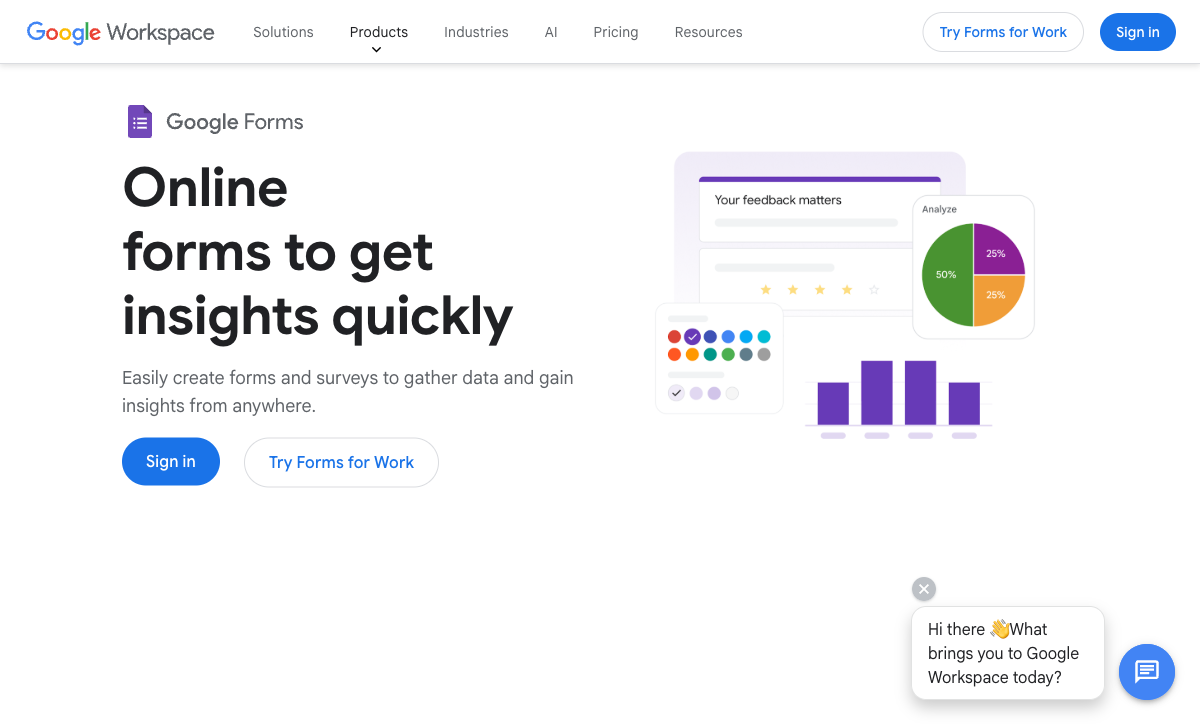
Google Forms is free in a way no competitor matches. Unlimited forms, unlimited submissions, unlimited respondents -- no paywalls, no "upgrade to unlock" prompts, no submission caps. Jotform's free plan limits you to 5 forms and 100 monthly submissions. Every other form builder eventually asks you to pay. Google Forms never does. For budget-constrained teams, students, nonprofits, educators, and anyone who needs basic data collection without spending a cent, this is the defining advantage.
Zero Learning Curve
If you can use Google Docs, you can use Google Forms. The interface is instantly familiar to anyone in the Google ecosystem -- add a question, choose a type, publish. There are no widgets to configure, no templates to navigate, no nested settings menus. Jotform's drag-and-drop editor is more powerful but requires learning where features live across hundreds of widgets and configuration panels. For organisations where non-technical staff need to create forms (schools, small businesses, community groups), Google Forms' simplicity is a genuine productivity advantage.
Google Workspace Integration
Google Forms feeds directly into Google Sheets, Google Drive, Google Classroom, and Gmail. Responses auto-populate in Sheets with zero configuration. Teachers assign quizzes through Google Classroom with auto-grading. Form files store in Drive. The integration is seamless because it's all one ecosystem. Jotform integrates with Google Sheets and Drive too, but it's a third-party connection that requires setup and can occasionally break. If your organisation runs on Google Workspace, Google Forms is the native option -- no authentication, no API keys, no integration maintenance.
Quiz and Assessment Features
Google Forms has surprisingly capable quiz functionality: auto-grading, point values per question, answer explanations, score release timing, and question shuffling. For educators, trainers, and anyone running knowledge assessments, the quiz mode is built in and free. Jotform has quiz capabilities too, but they require more setup and are spread across multiple widgets rather than being a unified mode. Google Forms' quiz features also integrate with Google Classroom, making it the default choice in educational environments.
Collaborative Editing
Multiple team members can edit a Google Form simultaneously, just like Google Docs. Changes sync in real time, and the familiar Google sharing model (viewer, commenter, editor) makes access control intuitive. For teams that build forms collaboratively -- HR creating surveys, marketing teams designing lead forms, teachers co-developing assessments -- the collaboration model is instant and friction-free. Jotform supports team collaboration on paid plans, but it requires upgrading to access multi-user editing features that Google Forms includes for free.
Where Jotform Wins
Payment Collection (40+ Gateways)
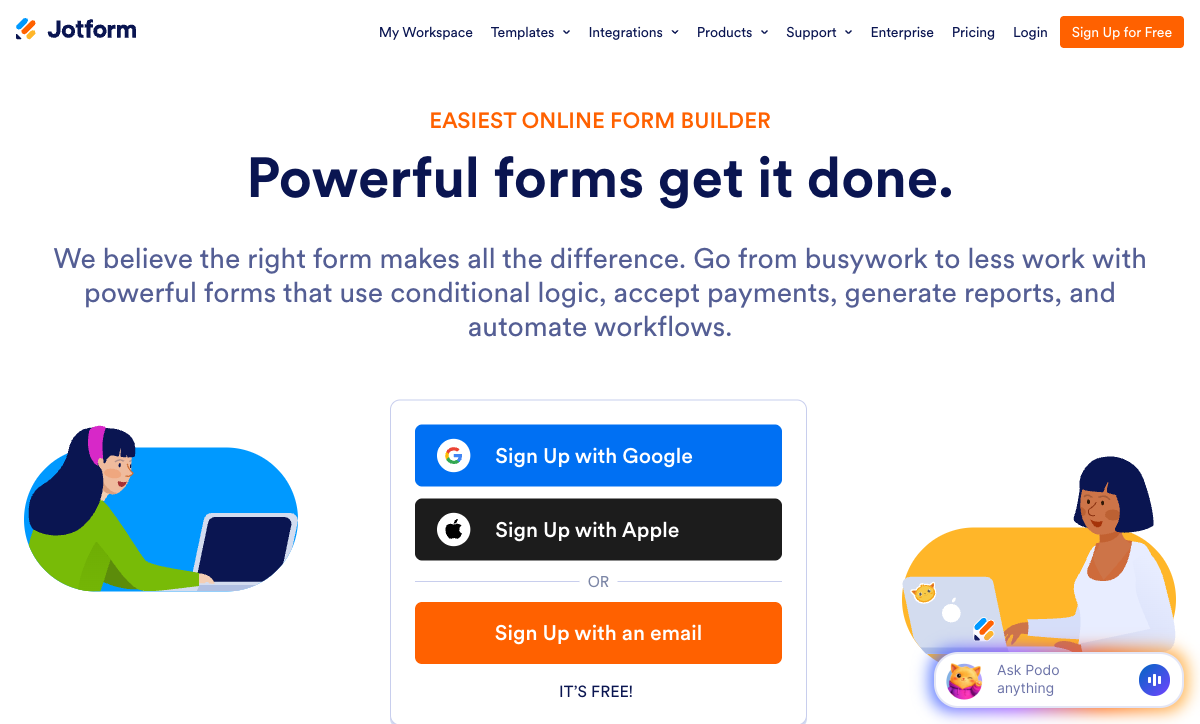
Google Forms cannot collect payments. Period. Jotform supports 40+ payment gateways including Stripe, PayPal, Square, Mollie, Payfast, and dozens of regional processors. You can sell products, accept donations, collect event fees, process subscriptions, and handle transactions directly through forms. For any use case involving money -- eCommerce, fundraising, event registration, invoicing -- Jotform is the only option between these two. This single feature gap is the primary reason people upgrade from Google Forms.
20,000+ Templates
Jotform's template library dwarfs Google Forms' limited selection. With 20,000+ templates covering industries from healthcare to real estate, you can start with a professionally designed form for almost any use case. Google Forms offers a handful of basic templates (about 20) that all look like Google Forms. If you need a polished starting point -- a professional intake form, a branded registration page, a styled survey -- Jotform's library saves hours of design work. The quality varies (some are community-submitted), but the breadth is unmatched.
Conditional Logic and Advanced Forms
Jotform offers full conditional logic: show/hide individual fields, skip pages, change field values, trigger calculations, and create dynamic form experiences based on user responses. Google Forms only supports section-level branching -- you can send users to different sections, but you can't show/hide individual fields or create complex multi-condition rules. For forms that need to adapt to user input (intake questionnaires, diagnostic tools, multi-path surveys), Jotform's logic capabilities are in a different league.
HIPAA Compliance
Jotform offers HIPAA compliance with Business Associate Agreements on paid plans, enabling healthcare organisations to collect Protected Health Information through web forms. Google Forms is not HIPAA-compliant for form submissions (Google Workspace has some HIPAA features, but Forms specifically lacks the required access controls and audit logging). For medical practices, therapists, healthcare intake, and any PHI collection, Jotform is compliant and Google Forms is not.
E-Signatures and PDF Generation
Jotform includes Jotform Sign for collecting legally binding e-signatures and PDF generation for creating formatted documents from form submissions. Google Forms has neither. For contracts, consent forms, waivers, lease agreements, or any document that requires a signature, Jotform provides the tooling. Google Forms would require exporting data to a separate tool (DocuSign, HelloSign) to handle signatures, adding complexity and cost.
Design Customisation and Branding
Jotform offers extensive design customisation: custom themes, font selection, colour palettes, background images, CSS injection on higher plans, and the ability to embed forms with custom styling that matches your website. Google Forms allows a header image and an accent colour -- that's the full extent of visual customisation. Every Google Form is instantly recognisable as a Google Form, complete with Google branding and the standard purple/blue/green colour options. For businesses that need forms matching their brand identity -- client intake, lead capture, event registration -- Jotform's design flexibility is a meaningful upgrade.
Mobile App and Offline Data Collection
Jotform's dedicated mobile app (iOS and Android) lets you build forms, view submissions, receive push notifications, and collect data offline -- useful for events, field work, and trade shows with unreliable internet. Google Forms is mobile-responsive for respondents but offers no dedicated mobile app for form creators. Building or editing forms requires a desktop browser. For teams that manage forms on the go or collect data in the field, Jotform's mobile app fills a gap Google Forms doesn't address.
Where Google Forms Falls Short
- No payment processing: Zero ability to collect payments, sell products, or handle transactions. This is the single biggest limitation.
- Minimal design customisation: You can change the header image and accent colour, but fonts, layouts, and overall styling are locked. Every Google Form looks like a Google Form.
- Basic conditional logic only: Section-level branching exists, but field-level show/hide, calculations, and complex rules don't. Forms can't adapt dynamically to user input.
- No integrations beyond Google: No native Zapier/Make triggers, no CRM connections, no webhook support. Data flows into Google Sheets and that's essentially it (third-party add-ons exist but are limited).
- Google branding: Forms carry Google's visual identity and URL structure. You can't white-label or fully brand the form experience for professional use. Every form lives on a docs.google.com URL, which undermines brand credibility for client-facing forms.
- No e-signatures: Cannot collect legally binding electronic signatures. Contracts, consent forms, and waivers require separate tools.
Where Jotform Falls Short
- Free plan limitations: 5 forms and 100 monthly submissions. If you've been using Google Forms' unlimited free tier, Jotform's caps feel restrictive immediately.
- Cluttered interface: 20 years of features packed into one editor. Multiple reviewers note the learning curve and difficulty finding specific settings in nested menus.
- Performance issues on complex forms: G2 and Capterra reviews consistently mention lag, slow loading, and sluggish rendering on forms with many fields or heavy conditional logic.
- Cost adds up quickly: The Starter plan at $39/month for 100 submissions is a steep jump from free. Higher tiers ($49/month for 250 submissions, $99/month for 1,000) can be hard to justify for small teams. The per-submission pricing means costs scale directly with usage, which can surprise organisations during high-traffic periods.
- Inconsistent feature quality: Jotform builds broadly rather than deeply. Individual features exist but don't always work as smoothly as dedicated tools. The gap between "feature listed" and "feature polished" is real.
See Them in Action
The best way to understand the difference between these two platforms is to see them in use. Google Forms' minimalist approach and Jotform's feature-rich builder create fundamentally different workflows and outputs.
Google Forms can be set up in under 2 minutes for a basic survey -- open the editor, type questions, and share the link. Jotform's setup is longer but produces more customised results: choose from 20,000+ templates, configure conditional logic, add payment widgets, and style the form to match your brand. The time investment correlates directly with the complexity of your needs.
Pricing Comparison
This is where the comparison gets stark. Google Forms is free. Jotform starts free but gets expensive quickly. The question is whether Jotform's features justify the cost over Google Forms' zero price tag.
| Tier | Google Forms | Jotform | Key Difference |
|---|---|---|---|
| Free | Unlimited forms, unlimited submissions, 15 GB Drive storage | 5 forms, 100 submissions, 100 MB storage | Google Forms is unlimited free. Jotform's free tier is capped but includes payments and logic. |
| ~$39/mo | N/A (Google Workspace is $7/user/mo but doesn't add form features) | Starter: $39/mo, 100 submissions, payments, conditional logic | Jotform's entry tier costs 5x a Workspace seat -- but adds payments, templates, and logic. |
| ~$49/mo | N/A | Bronze: $49/mo, 250 submissions, 1 GB storage | Google Forms remains free at any volume. Jotform's costs escalate with submissions. |
| ~$99/mo | N/A | Silver: $99/mo, 1,000 submissions, HIPAA | For high-volume or regulated use, Jotform's premium tiers are the only path. |
Google Forms
Jotform
| Product | Plan | Monthly Price | Annual Price (per month) | Free Plan | Free Trial | Limits |
|---|---|---|---|---|---|---|
| Google Forms | Free (Personal) | Free | Free | Yes | 14 days | forms: Unlimited, submissions: Unlimited, storage: 15 GB (shared across Google Drive), users: 1, file uploads: Included in 15 GB storage |
| Google Forms | Business Starter | $7/mo | $7/mo billed annually | forms: Unlimited, submissions: Unlimited, storage: 30 GB per user, users: Up to 300, file uploads: Included in storage | ||
| Google Forms | Business Standard | $14/mo | $14/mo billed annually | forms: Unlimited, submissions: Unlimited, storage: 2 TB per user, users: Up to 300, file uploads: Included in storage | ||
| Google Forms | Business Plus | $22/mo | $22/mo billed annually | forms: Unlimited, submissions: Unlimited, storage: 5 TB per user, users: Up to 300, file uploads: Included in storage | ||
| Jotform | Starter | Free | Free | Yes | No | forms: 5, submissions: 100/month, storage: 100 MB, users: 1 |
| Jotform | Bronze | $39/mo | $34/mo billed annually | forms: 25, submissions: 1,000/month, storage: 1 GB, users: 1 | ||
| Jotform | Silver | $49/mo | $39/mo billed annually | forms: 50, submissions: 2,500/month, storage: 10 GB, users: 1 | ||
| Jotform | Gold | $129/mo | $99/mo billed annually | forms: 100, submissions: 10,000/month, storage: 100 GB, users: 1 |
What Users Say
Google Forms doesn't accumulate traditional software reviews because it's a free tool bundled with Google accounts -- users don't typically "review" it on G2 or Capterra the way they review paid software. Its reputation is built on ubiquity: hundreds of millions of users know it works, it's free, and it's simple. The common criticism is that it's too basic for professional use.
Jotform has tens of thousands of reviews across platforms, averaging 4.6-4.7/5. Users praise the template library, payment integrations, and feature breadth. The consistent criticisms are interface complexity, performance degradation on large forms, and the gap between feature existence and feature polish. As EmailToolTester's 2026 review put it, Jotform has "everything but the kitchen sink" -- the challenge is navigating all of it.
Who Is Each Platform Best For?
Google Forms is ideal for: educators, students, nonprofits, internal team surveys, quick polls, basic feedback collection, event RSVPs, and any use case where free and simple is the priority. If you don't need payments, professional branding, or conditional logic, Google Forms does the job without costing anything. It's also the right choice for organisations where non-technical staff frequently create forms -- the zero learning curve means no training budget and no support tickets.
Jotform is ideal for: businesses that need payment collection, professional-looking forms, conditional logic, HIPAA compliance, e-signatures, or template-driven form creation. If you've outgrown Google Forms and need features that justify a monthly subscription, Jotform is a comprehensive upgrade. It's particularly suited for healthcare organisations (HIPAA), event businesses (payments + registration), and agencies that need diverse templates across client industries.
Neither platform is ideal for: businesses that need an Excel-style calculation engine for dynamic pricing, scoring, or conditional totals (consider Paperform). Neither offers the design polish of Typeform's conversational format, nor the deep survey methodology tools of SurveyMonkey. Teams needing WordPress-native form building should consider WPForms or Gravity Forms.
Consider Paperform: The Best of Both Worlds
If you're torn between Google Forms' simplicity and Jotform's feature depth, Paperform bridges the gap. Starting at $24/month, Paperform offers professional design quality that makes Google Forms look amateur, payment processing through 5 deeply integrated gateways (Stripe, PayPal, Square, Braintree, Google Pay), and an Excel-style calculation engine that neither Google Forms nor Jotform can match.
Paperform's document-style editor feels as intuitive as Google Forms -- you type content and add fields inline, like writing a document -- but produces forms that look like designed landing pages rather than generic form widgets. The calculation engine handles dynamic pricing, scoring, conditional totals, and computed values that flow into emails, integrations, and payment amounts. Built-in e-signatures (Papersign) and workflow automation (Stepper) are included at no extra cost.
For businesses that need more than Google Forms can offer but find Jotform's $39/month entry price steep for 100 submissions, Paperform delivers more features at a lower price with a cleaner interface. See our Paperform vs Jotform and Google Forms alternatives comparisons for the full breakdown.
The Verdict
Google Forms is the right choice when free and simple is genuinely enough. For surveys, quizzes, feedback forms, and basic data collection within the Google ecosystem, it's impossible to beat. No other form builder offers unlimited usage at zero cost with zero learning curve. The Google Sheets integration, collaborative editing, and quiz mode make it particularly strong for education and internal business use.
Jotform is the right choice when you need features Google Forms doesn't have -- particularly payments, professional design, conditional logic, HIPAA compliance, or e-signatures. The 20,000+ template library and 40+ payment gateways give you capabilities Google Forms will never offer. The trade-off is cost ($39/month and up) and complexity (a feature-dense interface that takes time to learn). Jotform's bootstrapped profitability and 20-year track record make it a safe long-term bet for organisations that need a comprehensive form platform.
The decision point is clear: if you've never wished Google Forms could do more, keep using it. It's free, it's simple, and it integrates perfectly with Google Workspace. If you regularly hit its limitations -- needing payments, branding, logic, or professional presentation -- it's time to upgrade. Whether that upgrade is Jotform, Paperform, or another platform depends on which features matter most to you.
Many organisations use both: Google Forms for internal, low-stakes data collection and a paid form builder for client-facing, revenue-generating forms. That's a perfectly valid approach. The tools aren't mutually exclusive. For more options, see our Google Forms alternatives or the full best form builders ranking.
Frequently Asked Questions
Is Google Forms really completely free?
Yes. Google Forms is 100% free with a personal Google account -- unlimited forms, unlimited submissions, unlimited respondents, and 15 GB of shared Google Drive storage. There are no hidden paywalls, no premium tiers for personal accounts, and no submission caps. The only paid option is Google Workspace (starting at $7/user/month), which adds team collaboration features, larger storage, and admin controls -- but the form builder itself is identical. For basic data collection, surveys, and quizzes, Google Forms is genuinely free in a way that no other form builder matches.
Can Jotform replace Google Forms for free?
Partially. Jotform's free plan offers 5 forms, 100 monthly submissions, and 100 MB storage, which covers basic use cases. But Google Forms has no form limit, no submission limit, and no storage cap (beyond the shared 15 GB Drive limit). If you need more than 5 forms or expect over 100 submissions per month, you'll need a paid Jotform plan. The reason to use Jotform's free tier over Google Forms is features -- payment collection, conditional logic, and templates -- not volume.
Which is better for collecting payments: Google Forms or Jotform?
There's no contest here. Google Forms has zero payment functionality. You cannot collect payments, sell products, or process transactions through Google Forms. Jotform supports 40+ payment gateways including Stripe, PayPal, Square, and dozens of regional processors. If you need to collect any form of payment through a form -- product sales, donations, event fees, subscriptions -- Jotform is the only option between these two. Alternatively, Paperform offers 5 deeply integrated gateways with built-in eCommerce features like subscriptions, coupons, and tax calculations at a lower price point.
Does Google Forms have conditional logic?
Google Forms has basic section-based branching -- you can send respondents to different sections based on their answer to a multiple-choice question. But it lacks field-level conditional logic (show/hide individual fields), calculation-based conditions, or complex multi-condition rules. Jotform offers full conditional logic: show/hide fields, skip pages, change form behaviour based on multiple conditions, and trigger actions based on answers. For simple "if answer A, go to section 2" logic, Google Forms works. For anything more sophisticated, Jotform or a platform like Paperform with its Excel-style calculation engine is necessary.
Can I use Google Forms for professional business purposes?
You can, but the limitations become visible quickly. Google Forms doesn't support custom branding (no custom fonts, limited colour options, Google branding visible), has no payment processing, offers minimal conditional logic, and produces output that looks like a Google Form -- recognisable and generic. For internal surveys, team feedback, and casual data collection, it's perfectly adequate. For client-facing forms, branded experiences, lead capture pages, or anything where professional presentation matters, Google Forms' design constraints will work against you. Most businesses outgrow Google Forms when they need payments, design control, or workflow automation.
Sources & References
- Best Online Form Builder to Use in 2026 -- Top 20 Tools — EmailToolTester, 2026
- The Best Online Form Builders for 2025 — Zapier, 2025
Last updated March 21, 2026
Ready to try Paperform?
Create beautiful forms, payment pages, and workflows — no code required.