Formsite vs Typeform: Legacy Workhorse vs Premium Design in 2026
Formsite and Typeform could not be more different. Formsite, founded in 1998 in Downers Grove, Illinois, is the internet's oldest surviving form builder — 28 years of continuous operation, billions of forms submitted, $500M+ in payments processed. It is functional, reliable, and looks like it was designed before smartphones existed. Typeform, founded in 2012 in Barcelona, built its entire brand on design — the one-question-at-a-time conversational interface that claims 3.5x higher completion rates, video forms, and an aesthetic that makes respondents actually want to engage.
This comparison pits the form builder industry's oldest survivor against its most design-conscious innovator. One prioritises function and durability. The other prioritises experience and engagement. They serve fundamentally different philosophies about what a form should be.
Quick Verdict
Choose Formsite if:
- You need traditional multi-question forms for data collection
- You need workflow automation with conditional routing
- You need document generation (PDF/Word) from submissions
- You want lower pricing for basic form building needs
- You need HIPAA compliance (though at a steep $209/month)
Choose Typeform if:
- Form design and respondent experience are your top priorities
- You're building surveys, quizzes, or lead generation forms
- You want conversational, one-question-at-a-time interactions
- You need video forms or interactive multimedia experiences
- You need drop-off analysis and conversion tracking analytics
Feature Comparison
Side-by-side: a 28-year legacy platform versus the design-first conversational form builder.
| Feature | Formsite | Typeform |
|---|---|---|
| Form Building | ||
| Document-style editor | No | No |
| AI form creation | Yes professional | Yes |
| Field types | Yes | 20+ |
| Multi-page forms | Yes | Yes basic |
| Guided mode (one question at a time) | No | Yes |
| Conditional logic | Yes | Yes basic |
| Calculations field | Yes | Yes plus |
| AI calculations assistant | No | No |
| Scoring | Yes | Yes plus |
| Answer piping | Yes | Yes basic |
| Pre-filling and hidden fields | Yes | Yes basic |
| Save and resume | Yes professional | No |
| Auto-close by number | Yes | Yes basic |
| Auto-close by date | Yes | Yes basic |
| Appointment/booking field | No | Yes basic |
| Signature field | Yes professional | No |
| Color picker field | No | No |
| API-powered dropdowns | No | No |
| Google address search | No | No |
| File uploads | No | Yes basic |
| AI follow-up questions | No | Yes business |
| Video questions | No | Yes basic |
| Payments | ||
| Stripe payments | Yes professional | Yes basic |
| PayPal payments | Yes professional | No |
| Square payments | No | No |
| Braintree payments | Yes professional | No |
| Google Pay | No | No |
| Product sales (eCommerce) | No | No |
| Subscriptions | No | Yes basic |
| Coupons and discounts | No | No |
| Custom pricing rules | Yes | No |
| Tax calculations | No | No |
| Quotes/invoices | No | No |
| Refunds | No | No |
| 3D Secure | No | Yes basic |
| Design & Customization | ||
| Template gallery | Yes | 1,500+ |
| Rich media (images, GIFs, videos) | Yes professional | Yes |
| Unsplash and Giphy integration | No | Yes |
| Image editor | No | No |
| Adobe Creative Cloud | No | No |
| Language translation | No | Yes basic |
| Advanced theming | Yes | Yes plus |
| Custom form URL | No | Yes plus |
| Custom domains | No | No |
| Custom HTML & CSS | Yes | Yes business |
| Remove branding | Yes professional | Yes plus |
| Custom email domains | No | No |
| Analytics | ||
| Submission results and reports | Yes | Yes |
| AI report insights | No | Yes business |
| Paperform analytics | No | No |
| Google Analytics & Facebook Pixel | No | Yes basic |
| Custom analytics scripts | No | Yes basic |
| Partial submissions | No | Yes plus |
| Drop-off analysis | No | Yes business |
| Collaboration | ||
| Multi-user accounts | Yes business | Yes plus |
| User permissions and management | Yes business | Yes plus |
| Advanced permissions & admin | No | Yes enterprise |
| Form sharing (templates) | Yes | Yes |
| Spaces and tag management | No | No |
| Workspace organization | No | Yes |
| Security | ||
| SOC 2 Type II | No | Yes |
| GDPR compliant | Yes | Yes |
| SSL encryption | Yes | Yes |
| Two-factor authentication | Yes enterprise | Yes |
| Enforce 2FA for all users | No | No |
| SSO (SAML) | No | Yes enterprise |
| reCAPTCHA | Yes professional | Yes business |
| Local data residency | No | No |
| Custom S3 storage | No | No |
| HIPAA compliance | Yes enterprise | No |
| HIPAA compliant | No | Yes enterprise |
| ISO 27001 | No | Yes |
| PCI DSS | No | Yes |
| Integrations & API | ||
| 2000+ integrations | Yes professional | No |
| Zapier | Yes professional | Yes basic |
| Make (Integromat) | No | Yes basic |
| Webhooks | Yes professional | Yes basic |
| Standard API | Yes professional | No |
| Business API | No | No |
| WordPress plugin | Yes | Yes |
| oEmbed support | No | No |
| Native integrations | No | 120+ (basic) |
| API | No | Yes basic |
| Embed options | No | Yes |
Where Formsite Wins
Lower Entry Price for Basic Forms
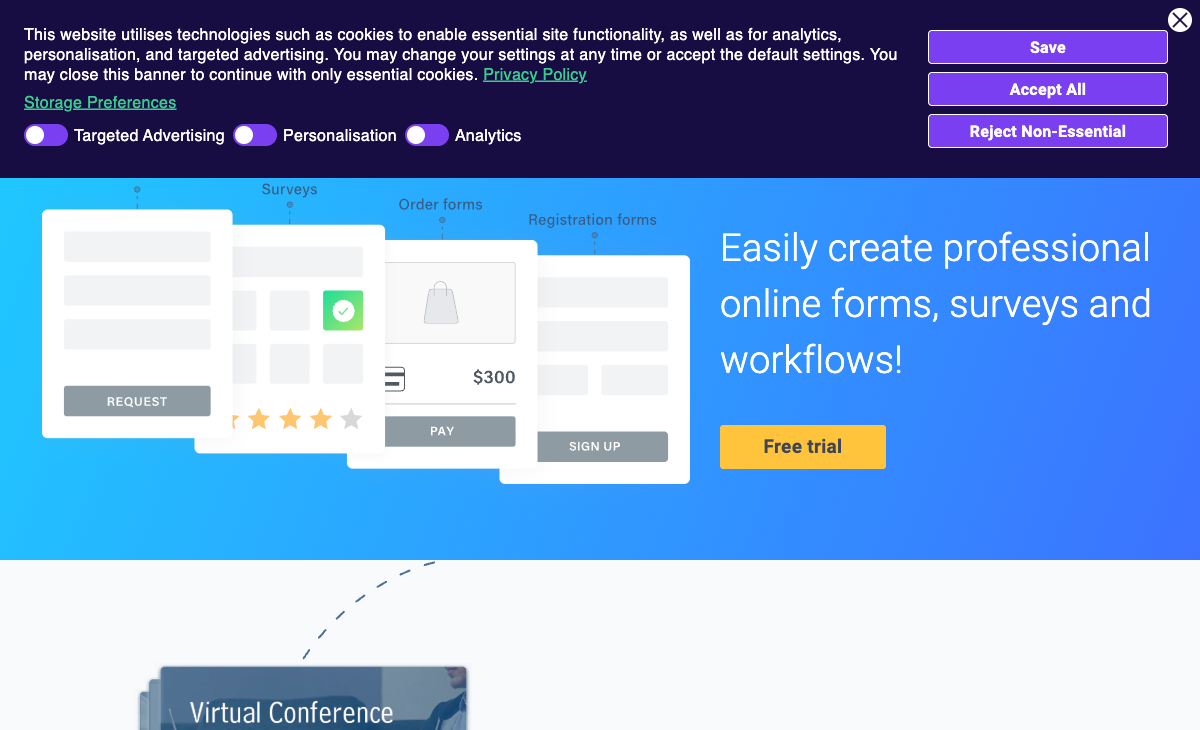
Formsite's Personal plan starts at $21/month (annual) with 5 forms and 500 results per form. Typeform's Basic plan is $28/month (annual) with 100 responses/month. For organisations that need simple data collection forms without design polish, Formsite is cheaper and includes more submission volume at the entry level. The pricing gap grows at mid-tiers: Formsite Professional ($34/month) includes payments and API access, while Typeform's comparable Plus plan is $56/month.
Workflow Automation
Formsite includes workflow automation on Business plans ($59/month) and above — conditional routing, multi-step approval chains, and automated actions based on form data. Typeform doesn't offer native workflow automation at the same depth. Typeform's "Smart routing" is available only on the Growth Pro plan ($266/month annual), making it extremely expensive for workflow needs. For organisations that need form submissions to trigger multi-step review and approval processes, Formsite handles this at a fraction of Typeform's cost.
Traditional Form Layouts
Not everyone wants a conversational interface. For long registration forms, detailed applications, and data-entry workflows, traditional multi-question layouts let respondents see all fields at once, compare options, and fill in information more efficiently. Typeform's one-question-at-a-time approach can feel slow for forms with 20+ fields. Formsite's traditional layout is faster for respondents who know what they want to enter and just need to get through the form.
Document Generation
Formsite generates PDF and Word documents from form submissions on Business+ plans. Useful for creating formatted reports, contracts, or receipts directly from submitted data. Typeform doesn't offer native document generation — you'd need third-party integrations to create documents from form submissions.
More Payment Gateway Options
Formsite supports Stripe, PayPal, Braintree, and Authorize.Net on the Professional plan. Typeform supports only Stripe on the Basic plan. For businesses that need PayPal, Braintree, or Authorize.Net specifically, Formsite covers gateways that Typeform doesn't offer.
Per-Form Submission Model
Formsite's submission limits are per form (e.g., 500 results per form on Personal, 2,500 on Business). Typeform's limits are monthly totals across all forms (100 on Basic, 1,000 on Plus, 10,000 on Business). For accounts with many low-volume forms, Formsite's per-form model can be significantly more generous.
Where Typeform Wins
Design Quality and Respondent Experience
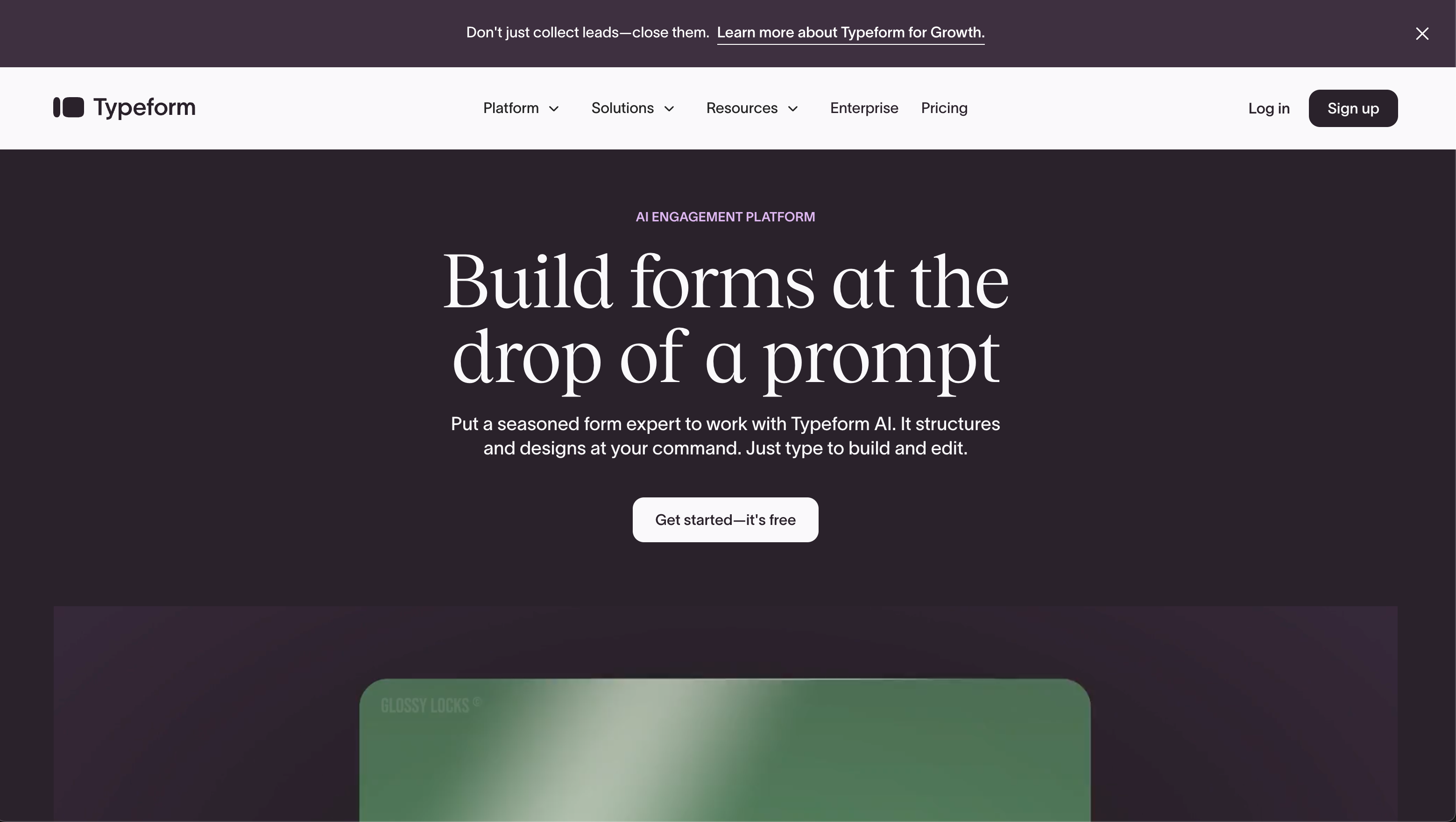
This is Typeform's defining advantage and it's not close. Typeform's one-question-at-a-time interface creates a focused, visually polished experience that makes respondents actually want to complete the form. Custom fonts, images, videos, GIFs, and brand-aligned design create forms that feel like curated experiences rather than data collection tools. Formsite forms look like products of 2005 — functional but visually dated. For any customer-facing form where brand perception matters, the design quality gap is a canyon.
Video Forms
Typeform offers video forms — record video prompts that play before questions, creating a personal, face-to-face feel in a digital form. This is a unique capability in the form builder space. Formsite has no video integration. For recruitment, customer feedback, and research where personal engagement matters, video forms are a meaningful differentiator.
Conversion Analytics
Typeform Business ($91/month annual) includes drop-off analysis showing exactly where respondents abandon forms, conversion tracking, and partial response data. These analytics treat forms as conversion funnels — actionable for optimising completion rates. Formsite offers basic reporting but nothing approaching Typeform's respondent behaviour analytics. For marketing teams and researchers, understanding why people don't complete your form is as valuable as the data from those who do.
AI Form Creation
Typeform includes AI-powered form creation — describe what you need in plain language and the AI generates a complete form with appropriate questions, logic, and styling. Formsite has no AI capabilities. As AI becomes standard in SaaS tools, Typeform is investing in the future while Formsite maintains the past.
HIPAA Compliance at Scale
Typeform offers HIPAA compliance on Enterprise plans with SSO, SOC 2, ISO 27001, and dedicated support. While both platforms offer HIPAA, Typeform's compliance comes with broader security certifications and enterprise features. Formsite offers HIPAA on its Enterprise plan at $209/month, but without the ISO 27001 and SOC 2 certifications that Typeform holds. For organisations with strict security requirements beyond HIPAA, Typeform's certification portfolio is stronger.
Enterprise Security Credentials
Typeform holds ISO 27001, SOC 2, PCI DSS, GDPR, HIPAA, and CCPA certifications. 451-1,000 employees, $141M revenue, 150,000+ businesses, serving 95% of the Fortune 500. Formsite's 2-10 person team and recent acquisition by Formstack can't match these enterprise credentials. For procurement processes that require security certifications and vendor stability assessments, Typeform checks more boxes.
Integration Ecosystem
Typeform connects to Salesforce, HubSpot, Slack, Google Sheets, Zapier, Make, and dozens of marketing, CRM, and productivity tools. The integration quality — especially with CRM and marketing platforms — reflects Typeform's focus on lead generation and marketing use cases. Formsite connects to Salesforce (Enterprise only), Zapier, and a smaller set of direct integrations. Typeform's ecosystem is broader and better maintained.
Where Formsite Falls Short
- Severely dated design: Formsite's builder and resulting forms look like products from 2005. In a comparison with Typeform's premium design, the visual gap is jarring.
- Acquired by Formstack: Formstack already has its own form builder, creating product overlap and uncertainty about Formsite's long-term future.
- Tiny team (2-10 employees): Minimal development capacity, support bandwidth, and product investment compared to Typeform's 451-1,000 employees.
- No AI capabilities: No AI form generation or AI-powered features.
- No video forms: No video integration of any kind.
- No conversion analytics: Basic reporting only — no drop-off analysis, no conversion tracking, no partial response insights.
- Limited templates: ~100 templates versus Typeform's larger library.
- Restrictive free plan: 5 forms, 10 results per form, no payments, no integrations, no email notifications — one of the weakest free plans available.
- No mobile app: No native mobile app for form building or data collection.
Where Typeform Falls Short
- Expensive for what you get: Typeform Basic at $28/month gives you only 100 responses/month. Formsite's $21/month Personal plan offers 500 per form. The cost-per-response ratio heavily favours Formsite.
- Strict response limits: 100/month (Basic), 1,000 (Plus), 10,000 (Business). Overages require plan upgrades. Formsite's per-form model can be more generous for multi-form accounts.
- Single payment gateway: Stripe only. Formsite offers Stripe, PayPal, Braintree, and Authorize.Net. For businesses needing PayPal or alternative gateways, Typeform falls short.
- No document generation: No native PDF/Word output from form submissions.
- Conversational format isn't always better: For long registration forms, detailed applications, and data-entry workflows, one-question-at-a-time can feel tedious. Traditional layouts are more efficient for certain form types.
- VC-funded with high burn: $193M in venture capital raised. While revenue is $141M, the VC-funded model means pressure for growth and potential pricing increases. Formsite, despite its issues, has no VC pressure.
- No workflow automation on affordable plans: Smart routing requires Growth Pro at $266/month. Formsite offers workflows at $59/month.
Pricing Comparison
Formsite is cheaper for basic data collection. Typeform charges a premium for design quality and conversion analytics.
| Feature Level | Formsite | Typeform | Key Difference |
|---|---|---|---|
| Free | 5 forms, 10 results/form, no payments | 10 forms, 10 responses/mo, basic AI | Both extremely limited; Typeform includes AI |
| ~$21-28/mo | Personal: $21/mo, 5 forms, 500 results/form | Basic: $28/mo, unlimited forms, 100 responses/mo | Formsite: more submissions, cheaper. Typeform: better design |
| ~$34-56/mo | Professional: $34/mo, 10 forms, payments, API | Plus: $56/mo, 1,000 responses, no branding, priority support | Formsite is 40% cheaper; Typeform adds design polish and support |
| ~$59-91/mo | Business: $59/mo, 25 forms, workflows, PDF | Business: $91/mo, 10,000 responses, Salesforce, analytics | Formsite: workflows at lower cost. Typeform: analytics and CRM |
| Enterprise | $209/mo, HIPAA, SLA, Salesforce | Custom pricing, SSO, ISO 27001, SOC 2 | Typeform has stronger security certs; Formsite is fixed-price |
Formsite is consistently 30-50% cheaper at comparable tiers, but the comparison is misleading — you're comparing a dated data collection tool against a premium design platform. Typeform's pricing reflects its design quality, conversion analytics, and modern capabilities. The question is whether that premium produces enough additional value (higher completion rates, better brand impression, conversion insights) to justify the cost difference.
Formsite
Typeform
| Product | Plan | Monthly Price | Annual Price (per month) | Free Plan | Free Trial | Limits |
|---|---|---|---|---|---|---|
| Formsite | Free | Free | Free | Yes | 14 days | forms: 5, submissions: 10 per form, storage: 50 MB, users: 1 |
| Formsite | Personal | $21/mo | $20.83/mo billed annually | forms: 5, submissions: 500 per form, storage: 500 MB, users: 1 | ||
| Formsite | Professional | $34/mo | $33.33/mo billed annually | forms: 10, submissions: 1,000 per form, storage: 1 GB, users: 1 | ||
| Formsite | Business | $59/mo | $58.33/mo billed annually | forms: 25, submissions: 2,500 per form, storage: 2 GB, users: 2 | ||
| Formsite | Business + | $84/mo | $83.33/mo billed annually | forms: 100, submissions: 10,000 per form, storage: 4 GB, users: 6 | ||
| Formsite | Enterprise | $209/mo | $208.33/mo billed annually | forms: 1000, submissions: 50,000 per form, storage: 10 GB, users: 21 | ||
| Typeform | Free | Free | Free | Yes | No | forms: 10, submissions: 10/month, users: 1 |
| Typeform | Basic | $39/mo | $28/mo billed annually | forms: Unlimited, submissions: 100/month, users: 1 | ||
| Typeform | Plus | $79/mo | $56/mo billed annually | forms: Unlimited, submissions: 1,000/month, users: 3 | ||
| Typeform | Business | $129/mo | $91/mo billed annually | forms: Unlimited, submissions: 10,000/month, users: 5 | ||
| Typeform | Growth Pro | $379/mo | $266/mo billed annually | forms: Unlimited, submissions: Expanded, users: Expanded |
What Users Say
Typeform averages 4.5-4.7/5 across G2 and Capterra, with strong praise for design quality, respondent experience, and brand impression. Common complaints include the strict response limits, Stripe-only payments, and pricing that escalates quickly at higher volumes.
Formsite averages 4.3-4.5/5, with long-time users praising reliability and workflow capabilities. Complaints centre on the dated interface, limited design options, and lack of modern features. The review volume gap (Typeform has significantly more reviews) reflects the user base size difference. Both platforms have loyal users, but Typeform's audience is growing while Formsite's has plateaued.
Consider Paperform
If Formsite is too dated and Typeform too expensive for limited responses, Paperform occupies an appealing middle ground. Its document-style editor creates forms that look like designed landing pages — rivalling Typeform's visual quality with a different approach (document-style versus conversational). But unlike Typeform, Paperform includes five payment gateways (Stripe, PayPal, Square, Braintree, Google Pay) on every plan, an Excel-style calculation engine that powers dynamic pricing and scoring across questions, pages, emails, and integrations, built-in e-signatures via Papersign, and 30,000+ templates. At $24/month (Essentials), Paperform delivers design quality comparable to Typeform with more features than either platform. Bootstrapped and profitable, it offers the long-term stability that Formsite's acquisition and Typeform's VC funding cannot guarantee. See the full form builders ranking for details.
Frequently Asked Questions
Does Typeform actually get higher response rates?
Typeform claims 3.5x higher completion rates compared to standard forms, and there's reasonable evidence that one-question-at-a-time interfaces can improve engagement for certain form types — particularly surveys, quizzes, and lead generation forms. The conversational format reduces visual overwhelm and creates a more focused experience. However, for transactional forms (order forms, applications, registrations), multi-question layouts can be more efficient. Formsite's traditional all-at-once format may actually be faster for respondents who want to complete a form quickly rather than being guided through it question by question. The "higher response rate" claim depends heavily on the form type and audience.
Which is better for collecting payments?
Formsite supports Stripe, PayPal, Braintree, and Authorize.Net on the Professional plan ($34/month). Typeform supports Stripe on the Basic plan ($28/month annual). Formsite offers more payment gateway options, but Typeform's payment experience is more visually polished — payments feel like a natural part of the conversational flow. For simple payment collection with design quality, Typeform edges ahead. For gateway variety and traditional order forms, Formsite has more options. Neither platform matches dedicated payment form builders in depth.
Is Formsite being sunset after the Formstack acquisition?
Formstack has not announced plans to sunset Formsite. As of 2026, Formsite continues to operate under its own brand with its own pricing and feature set. However, Formstack already has its own form builder product (Formstack Forms), creating obvious product overlap. The acquisition could result in eventual consolidation, migration to Formstack, or continued independent operation. There's no public roadmap for Formsite's future under Formstack ownership. If you're choosing a platform for long-term use, this uncertainty is worth factoring in.
Which offers better analytics and insights?
Typeform offers stronger analytics — drop-off analysis (see where respondents abandon), conversion tracking, and partial response data on the Business plan ($91/month annual). These metrics are valuable for optimising form completion rates. Formsite offers basic reporting and can generate PDF results, but doesn't provide the same depth of respondent behaviour analytics. For teams that treat forms as conversion funnels (marketing, lead generation, product research), Typeform's analytics capabilities are significantly more useful.
Sources & References
- Formsite vs Typeform Comparison — G2, 2026
- Best Form Builder Software for 2026 — PCMag, 2026
Last updated March 21, 2026
Ready to try Paperform?
Create beautiful forms, payment pages, and workflows — no code required.