FormAssembly vs Gravity Forms: Salesforce SaaS or WordPress Plugin? (2026)
FormAssembly and Gravity Forms represent two entirely different architectures. FormAssembly is a standalone SaaS platform built around Salesforce integration and enterprise compliance — starting at $59/month. Gravity Forms is a WordPress plugin that extends WordPress with powerful form capabilities — starting at $59/year. They share almost no target audience.
The primary decision factor is your tech stack. If you run WordPress, Gravity Forms is the native choice. If you need Salesforce integration with enterprise compliance, FormAssembly is purpose-built for that. The two rarely compete directly.
Quick Verdict
Choose FormAssembly if:
- You need deep Salesforce integration (native multi-object sync)
- You need FedRAMP, HIPAA, or PCI DSS compliance at the platform level
- You want a standalone SaaS — no WordPress required
- Enterprise procurement requires vendor-managed security certifications
Choose Gravity Forms if:
- You run WordPress and want native form integration
- You want annual pricing ($59-$259/year vs $59/month)
- You need a large add-on ecosystem for WordPress-specific features
- You want full control over data — self-hosted on your server
Feature Comparison
Side-by-side across feature categories — SaaS enterprise vs WordPress plugin.
| Feature | FormAssembly | Gravity Forms |
|---|---|---|
| Form Building | ||
| Document-style editor | No | No |
| AI form creation | Yes explorer | No |
| Field types | Yes explorer | No |
| Multi-page forms | Yes explorer | Yes Basic |
| Guided mode (one question at a time) | No | Yes Elite |
| Conditional logic | Yes explorer | Yes Basic |
| Calculations field | Yes explorer | Yes Basic |
| AI calculations assistant | No | No |
| Scoring | No | Yes Elite |
| Answer piping | Yes explorer | Yes Basic |
| Pre-filling and hidden fields | Yes explorer | Yes Basic |
| Save and resume | Yes explorer | Yes Basic |
| Auto-close by number | Yes explorer | No |
| Auto-close by date | Yes explorer | No |
| Appointment/booking field | No | No |
| Signature field | Yes explorer | Yes Elite |
| Color picker field | No | No |
| API-powered dropdowns | Yes team | No |
| Google address search | No | No |
| Drag-and-drop builder | No | Yes Basic |
| 30+ field types | No | Yes Basic |
| Payments | ||
| Stripe payments | Yes explorer | Yes Pro |
| PayPal payments | Yes explorer | Yes Pro |
| Square payments | No | Yes Pro |
| Braintree payments | No | No |
| Google Pay | No | Yes Pro |
| Product sales (eCommerce) | Yes explorer | Yes Basic |
| Subscriptions | No | Yes Pro |
| Coupons and discounts | No | Yes Elite |
| Custom pricing rules | Yes explorer | No |
| Tax calculations | No | No |
| Quotes/invoices | No | No |
| Refunds | No | Yes Pro |
| 3D Secure | No | Yes Pro |
| Design & Customization | ||
| Template gallery | Yes explorer | Yes Basic |
| Rich media (images, GIFs, videos) | Yes explorer | Yes Basic |
| Unsplash and Giphy integration | No | No |
| Image editor | No | No |
| Adobe Creative Cloud | No | No |
| Language translation | No | Yes Basic |
| Advanced theming | Yes team | Yes Basic |
| Custom form URL | Yes explorer | No |
| Custom domains | No | No |
| Custom HTML & CSS | Yes team | Yes Basic |
| Remove branding | Yes team | Yes Basic |
| Custom email domains | No | Yes Elite |
| Analytics | ||
| Submission results and reports | Yes explorer | Yes Basic |
| AI report insights | No | No |
| Workflow analytics | Yes explorer | No |
| Google Analytics & Facebook Pixel | No | Yes Elite |
| Custom analytics scripts | No | Yes Basic |
| Partial submissions | No | Yes Elite |
| Paperform analytics | No | No |
| Collaboration | ||
| Multi-user accounts | Yes team | Yes Basic |
| User permissions and management | Yes team | Yes Basic |
| Advanced permissions & admin | Yes enterprise | No |
| Form sharing (templates) | Yes explorer | Yes Basic |
| Spaces and tag management | No | No |
| Security | ||
| SOC 2 Type II | Yes explorer | No |
| GDPR compliant | Yes explorer | Yes Basic |
| SSL encryption | Yes explorer | Yes Basic |
| Two-factor authentication | Yes explorer | No |
| Enforce 2FA for all users | Yes enterprise | No |
| SSO (SAML) | Yes enterprise | No |
| reCAPTCHA | Yes explorer | Yes Basic |
| Local data residency | Yes enterprise | Yes Basic |
| Custom S3 storage (BYO) | No | No |
| Integrations & API | ||
| 2000+ integrations | No | No |
| Zapier | No | Yes Pro |
| Make (Integromat) | No | No |
| Webhooks | Yes explorer | Yes Elite |
| Standard API | Yes explorer | Yes Basic |
| Business API | No | No |
| WordPress plugin | Yes explorer | Yes Basic |
| oEmbed support | Yes explorer | No |
| 50+ official add-ons | No | Yes Basic |
| Stepper workflow automation | No | No |
Where FormAssembly Wins
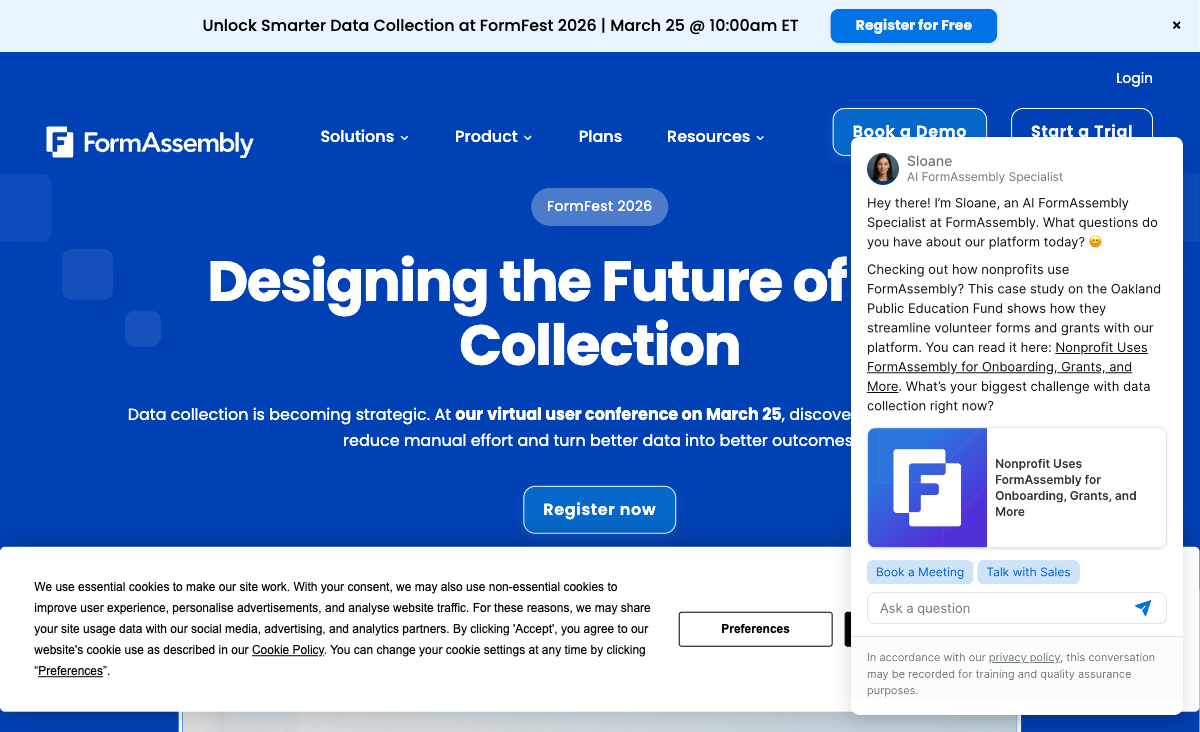
Salesforce Integration Depth
FormAssembly's native Salesforce connector supports multi-object mapping, prefilling from Salesforce records, and Agentforce support — the deepest Salesforce integration available in any form builder. Gravity Forms can connect to Salesforce via third-party add-ons and Zapier, but these provide only basic single-object field mapping. For organisations where form-to-Salesforce data precision is critical, FormAssembly is the only serious option.
Platform-Level Compliance
FormAssembly holds HIPAA with BAA, PCI DSS Level 1, SOC 2, GDPR, FERPA, and FedRAMP High. As a SaaS platform, these certifications cover the entire stack. Gravity Forms is self-hosted, so compliance depends on your WordPress hosting, server configuration, and security practices. For regulated industries where vendor-managed compliance simplifies procurement, FormAssembly's certifications are a decisive advantage.
CMS Independence
FormAssembly works independently of any CMS. You can embed forms on any website, share via links, or use them in standalone workflows. Gravity Forms requires WordPress — if you migrate away from WordPress, your forms don't come with you. For organisations that might change their CMS or need forms across multiple platforms, FormAssembly's independence is valuable.
Where Gravity Forms Wins
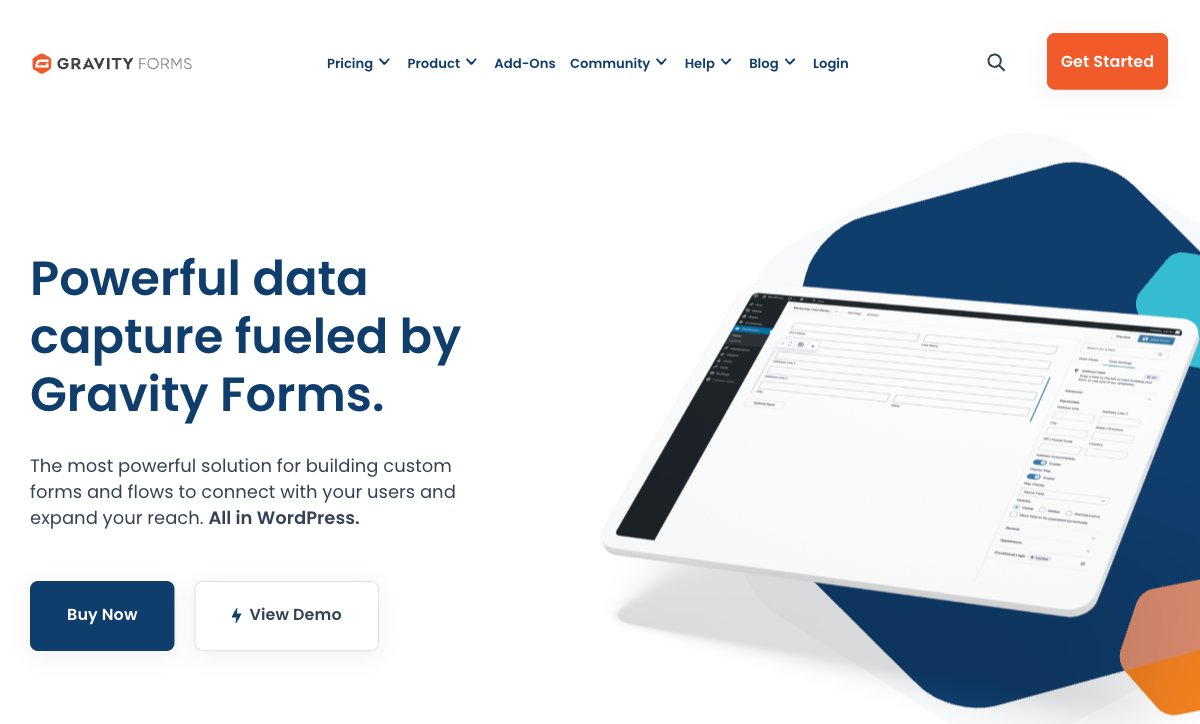
Price: $59/Year vs $59/Month
Gravity Forms' Basic license costs $59/year — the same as one month of FormAssembly. The Elite license at $259/year still costs less than five months of FormAssembly's entry plan. For WordPress-based businesses, Gravity Forms delivers powerful form capabilities at a fraction of FormAssembly's cost. The annual pricing model also means no monthly recurring charges beyond WordPress hosting.
WordPress Ecosystem
Gravity Forms has the deepest WordPress integration of any form plugin. Native compatibility with popular themes, page builders (Elementor, Divi, Beaver Builder), and a massive add-on ecosystem for payments, CRM connections, email marketing, and advanced features. FormAssembly can be embedded in WordPress via iframe, but the integration is surface-level compared to Gravity Forms' native WordPress hooks and filters.
Self-Hosted Data Control
Form submissions are stored on your WordPress server — you control the data, the backups, and the infrastructure. FormAssembly stores data on their servers. For organisations with data sovereignty requirements or those who prefer self-hosted solutions, Gravity Forms' architecture puts data control entirely in your hands.
Developer Extensibility
Gravity Forms' hooks, filters, and REST API make it extremely extensible for WordPress developers. Custom field types, conditional logic extensions, and workflow automation can be built with PHP. FormAssembly is a closed SaaS platform with less developer extensibility. For WordPress development teams, Gravity Forms is a more flexible foundation.
Where FormAssembly Falls Short
- Expensive: $59/month vs $59/year. The 12x price difference is hard to justify without Salesforce or compliance needs.
- Steep learning curve: G2 ease of use rated 4.1/5. Non-Salesforce users find the interface unintuitive.
- Limited integrations: Roughly 20 native connectors, no Zapier or Make. Outside Salesforce, connectivity is poor.
- No free plan: Only a 14-day trial. Gravity Forms at least offers a 30-day refund guarantee.
Where Gravity Forms Falls Short
- WordPress dependency: Cannot function without WordPress. If you leave WordPress, you lose your forms.
- No native Salesforce depth: Third-party add-ons provide basic mapping only. Complex multi-object sync isn't possible.
- Self-managed compliance: No platform-level HIPAA, FedRAMP, or PCI DSS. You're responsible for the entire stack.
- Hosting overhead: You need WordPress hosting, maintenance, updates, and security. FormAssembly is fully managed.
- No standalone forms: Forms live inside WordPress. Sharing via direct link requires extra configuration.
Pricing Comparison
Dramatically different pricing models — annual plugin license vs monthly SaaS:
| Tier | FormAssembly | Gravity Forms | Key Difference |
|---|---|---|---|
| Entry | Explorer: $59/mo — Salesforce, 3 workflows | Basic: $59/yr — 1 site, core add-ons | Gravity Forms costs 12x less annually |
| Mid-Tier | Team: Custom pricing | Pro: $159/yr — 3 sites, more add-ons | Gravity Forms transparent pricing; FormAssembly requires sales |
| Top Tier | Enterprise: Custom — HIPAA, FedRAMP, SLA | Elite: $259/yr — unlimited sites, all add-ons | FormAssembly adds compliance; Gravity Forms adds site licenses |
FormAssembly
Gravity Forms
| Product | Plan | Monthly Price | Annual Price (per month) | Free Plan | Free Trial | Limits |
|---|---|---|---|---|---|---|
| FormAssembly | Explorer | $59/mo | Not listed | No | 14 days | forms: Unlimited, submissions: Unlimited, storage: Unlimited, users: 1 standard user |
| FormAssembly | Team | Custom | Not listed | forms: Unlimited, submissions: Unlimited, storage: Unlimited, users: 3 standard + 5 limited users | ||
| FormAssembly | Enterprise | Custom | Not listed | forms: Unlimited, submissions: Unlimited, storage: Unlimited, users: 5 standard + 10 limited users | ||
| FormAssembly | Gov Cloud | Custom | Not listed | forms: Unlimited, submissions: Unlimited, storage: Unlimited, users: 5 standard + 10 limited users | ||
| Gravity Forms | Basic | Not listed | $59/mo billed annually | No | 14 days | forms: Unlimited, submissions: Unlimited, storage: WordPress database (self-hosted), users: Unlimited (WordPress users) |
| Gravity Forms | Pro | Not listed | $159/mo billed annually | forms: Unlimited, submissions: Unlimited, storage: WordPress database (self-hosted), users: Unlimited (WordPress users) | ||
| Gravity Forms | Elite | Not listed | $259/mo billed annually | forms: Unlimited, submissions: Unlimited, storage: WordPress database (self-hosted), users: Unlimited (WordPress users) | ||
| Gravity Forms | Nonprofit | Not listed | $129/mo billed annually | forms: Unlimited, submissions: Unlimited, storage: WordPress database (self-hosted), users: Unlimited (WordPress users) |
What Users Say
Gravity Forms earns consistent praise from WordPress developers for its extensibility, reliability, and deep ecosystem. FormAssembly reviews focus on Salesforce integration quality. The audiences rarely overlap — WordPress developers choose Gravity Forms; Salesforce admins choose FormAssembly. Complaints about FormAssembly centre on price and learning curve; complaints about Gravity Forms centre on WordPress dependency and occasional plugin conflicts.
Consider Paperform
If FormAssembly's Salesforce focus is overkill and Gravity Forms' WordPress requirement is a limitation, Paperform offers a standalone SaaS alternative. Paperform's document-style editor creates forms that look like designed landing pages, with an Excel-style calculation engine for dynamic pricing, scoring, and conditional logic.
At $24/month (annual), Paperform costs less than FormAssembly ($59/mo) and works without WordPress. It includes five payment gateways, 2,000+ integrations, 30,000+ templates, and a free plan. For businesses that need more than a WordPress plugin but less than a Salesforce specialist, Paperform is worth evaluating. See our full ranking for details.
The Verdict
Choose FormAssembly for Salesforce-centric enterprises. Its native multi-object Salesforce connector and FedRAMP + HIPAA + PCI DSS compliance serve regulated industries where form-to-CRM data precision matters. Founded in 2006, FormAssembly's 20-year track record provides enterprise procurement confidence.
Choose Gravity Forms for WordPress-based businesses. At $59/year, it delivers powerful form capabilities within WordPress at a fraction of FormAssembly's cost. The deep plugin ecosystem, self-hosted data control, and developer extensibility make it the best form solution for WordPress. Gravity Forms (Rocketgenius) has been in the market since 2009 — a stable, mature platform.
Frequently Asked Questions
Can Gravity Forms integrate with Salesforce?
Yes, through third-party add-ons and Zapier, but the integration is surface-level — basic field mapping to single Salesforce objects. FormAssembly's native Salesforce connector supports multi-object sync, prefilling from Salesforce records, and Agentforce support. If your WordPress site needs to feed data into complex Salesforce data models, FormAssembly is significantly more capable. For basic lead capture to Salesforce, Gravity Forms with Zapier may suffice.
Do I need WordPress to use either platform?
Gravity Forms requires WordPress — it's a WordPress plugin and cannot function without a WordPress installation. FormAssembly is a standalone SaaS platform that works independently of any CMS. If you don't have WordPress, Gravity Forms isn't an option. If you're moving away from WordPress, FormAssembly (or another SaaS form builder) gives you CMS independence.
Which is more affordable for small businesses?
Gravity Forms starts at $59/year (Basic license) — significantly cheaper than FormAssembly's $59/month. Even Gravity Forms' Elite license at $259/year costs less than four months of FormAssembly's Explorer plan. However, Gravity Forms requires WordPress hosting costs on top. Neither platform offers a free plan. For WordPress-based small businesses, Gravity Forms is dramatically more affordable. For businesses without WordPress, FormAssembly's SaaS model avoids hosting overhead.
Which has better compliance certifications?
FormAssembly holds HIPAA with BAA, PCI DSS Level 1, SOC 2, GDPR, FERPA, and FedRAMP High — the broadest compliance portfolio among form builders. Gravity Forms is a self-hosted WordPress plugin, so compliance depends entirely on your hosting environment and configuration. You can achieve HIPAA or PCI compliance with Gravity Forms, but you're responsible for the entire stack. FormAssembly handles compliance at the platform level, which is simpler for regulated organisations.
Sources & References
- FormAssembly vs Gravity Forms: Comparison — G2, 2026
- Gravity Forms Pricing — Gravity Forms, 2026
Last updated March 21, 2026
Ready to try Paperform?
Create beautiful forms, payment pages, and workflows — no code required.