Airtable Forms vs Typeform: Basic Widget or Premium Design? (2026)
At opposite ends of the form experience spectrum. Airtable Forms is a free, no-frills data entry widget — all fields visible at once, minimal styling, no logic. Typeform is a premium, design-first form builder — one question at a time, beautiful animations, conditional logic jumps, and a conversational experience that prioritises respondent engagement over raw data collection.
If you care about how your forms look and feel to respondents, Typeform is in a different category. If you care about where data goes and how it's managed afterward, Airtable's relational database wins. The real comparison is priorities: experience vs. backend.
Quick Verdict
Choose Airtable Forms if:
- You use Airtable and need simple record intake
- Design and respondent experience don't matter
- You need the relational database backend
- The form is internal — project requests, inventory, bug reports
- You want zero additional cost
Choose Typeform if:
- Form design and respondent experience are priorities
- You need conversational, one-question-at-a-time forms
- You need conditional logic jumps and branching
- You want higher completion rates on customer-facing forms
- You need payment processing (Stripe)
Feature Comparison
Typeform is a premium form experience; Airtable Forms is a basic data widget. The gap is wide on form-building features.
| Feature | Airtable Forms | Typeform |
|---|---|---|
| Form Building | ||
| Document-style editor | No | No |
| AI form creation | No | Yes |
| Field types | Yes | 20+ |
| Multi-page forms | No | Yes basic |
| Guided mode (one question at a time) | No | Yes |
| Conditional logic | No | Yes basic |
| Calculations field | No | Yes plus |
| AI calculations assistant | No | No |
| Scoring | No | Yes plus |
| Answer piping | No | Yes basic |
| Pre-filling and hidden fields | Yes | Yes basic |
| Save and resume | No | No |
| Auto-close by number | No | Yes basic |
| Auto-close by date | No | Yes basic |
| Appointment/booking field | No | Yes basic |
| Signature field | No | No |
| Color picker field | No | No |
| API-powered dropdowns | No | No |
| Google address search | No | No |
| File uploads | No | Yes basic |
| AI follow-up questions | No | Yes business |
| Video questions | No | Yes basic |
| Payments | ||
| Stripe payments | No | Yes basic |
| PayPal payments | No | No |
| Square payments | No | No |
| Braintree payments | No | No |
| Google Pay | No | No |
| Product sales (eCommerce) | No | No |
| Subscriptions | No | Yes basic |
| Coupons and discounts | No | No |
| Custom pricing rules | No | No |
| Tax calculations | No | No |
| Quotes/invoices | No | No |
| Refunds | No | No |
| 3D Secure | No | Yes basic |
| Design & Customization | ||
| Template gallery | No | 1,500+ |
| Rich media (images, GIFs, videos) | Yes | Yes |
| Unsplash and Giphy integration | No | Yes |
| Image editor | No | No |
| Adobe CC | No | No |
| Language translation | No | Yes basic |
| Advanced theming | Yes business | Yes plus |
| Custom form URL | No | Yes plus |
| Custom domains | No | No |
| Custom HTML & CSS | No | Yes business |
| Remove branding | Yes business | Yes plus |
| Custom email domains | No | No |
| Analytics | ||
| Submission results and reports | Yes | Yes |
| AI report insights | No | Yes business |
| Form analytics | No | No |
| Google Analytics & Facebook Pixel | No | Yes basic |
| Custom analytics scripts | No | Yes basic |
| Partial submissions | No | Yes plus |
| Drop-off analysis | No | Yes business |
| Collaboration | ||
| Multi-user accounts | Yes | Yes plus |
| User permissions and management | Yes team | Yes plus |
| Advanced permissions & admin | Yes enterprise | Yes enterprise |
| Form sharing (templates) | Yes | Yes |
| Workspace organization | Yes | Yes |
| Security | ||
| SOC 2 Type II | Yes | Yes |
| GDPR compliant | Yes | Yes |
| SSL encryption | Yes | Yes |
| Two-factor authentication | Yes | Yes |
| Enforce 2FA | Yes enterprise | No |
| SSO (SAML) | Yes business | Yes enterprise |
| reCAPTCHA | No | Yes business |
| Data residency | Yes enterprise | No |
| Custom S3 | No | No |
| HIPAA compliant | No | Yes enterprise |
| ISO 27001 | No | Yes |
| PCI DSS | No | Yes |
| Integrations & API | ||
| Native integrations | No | 120+ (basic) |
| Zapier | Yes | Yes basic |
| Make (Integromat) | Yes | Yes basic |
| Webhooks | Yes team | Yes basic |
| API | Yes | Yes basic |
| Business API | No | No |
| WordPress plugin | No | Yes |
| Embed options | Yes | Yes |
Where Airtable Forms Wins
Relational Database Backend
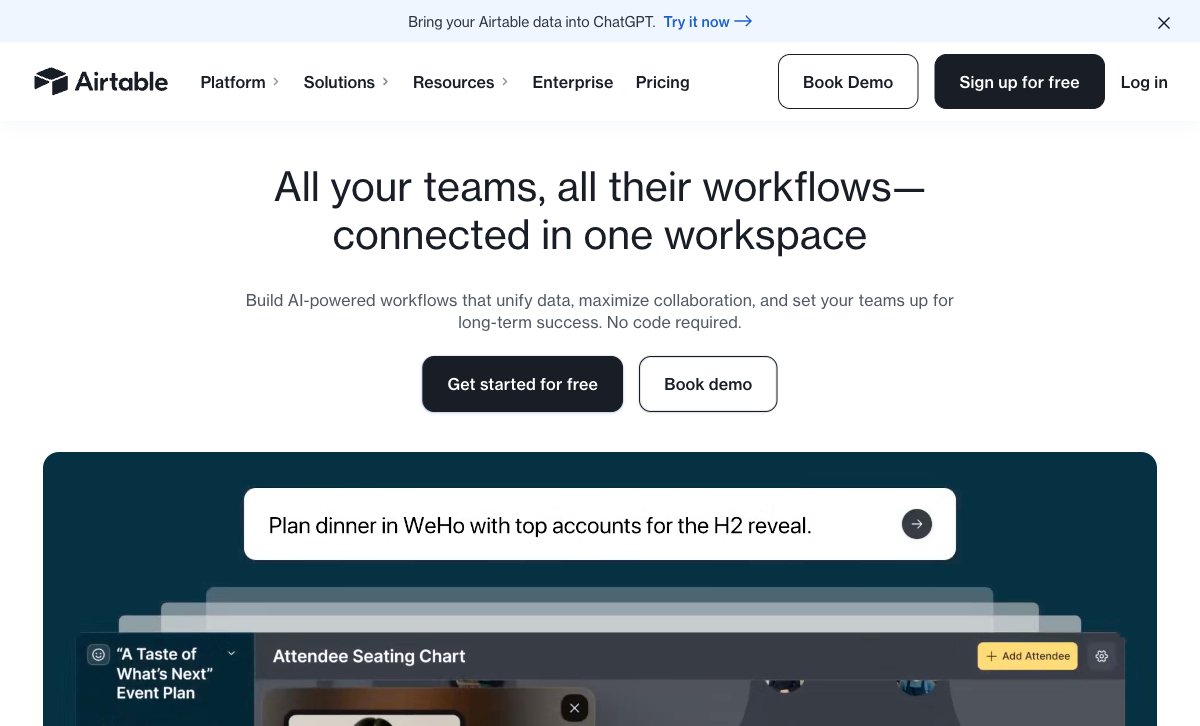
Airtable's database is the star — linked records, multiple views, automations, formulas, and rollups. Submissions become structured records in a system designed for data management. Typeform stores responses in its own results dashboard or sends them to integrations. For teams that need to relate, filter, and act on form data in a database, Airtable's backend is significantly more powerful.
Free With Airtable
Airtable Forms cost nothing. Typeform's free plan limits you to 10 responses/month — essentially a demo tier. Typeform's paid plans start at $25/month. For teams already on Airtable, the cost savings are substantial, especially at scale.
All Fields Visible at Once
For short internal forms, seeing all fields at once is actually faster than Typeform's one-at-a-time approach. A 5-field project request form is quicker to complete when you can see and fill everything in one view. Typeform's conversational format shines on longer, customer-facing forms but adds friction to quick internal submissions.
No Response Limits on Paid Plans
Airtable's limits are record-based (50,000 on Team plan), not response-based. Typeform's paid plans cap responses — Basic at 100/month, Plus at 1,000/month. For high-volume data collection, Airtable's record limits are more generous than Typeform's response caps, especially at lower price points.
Where Typeform Wins
Design and Respondent Experience
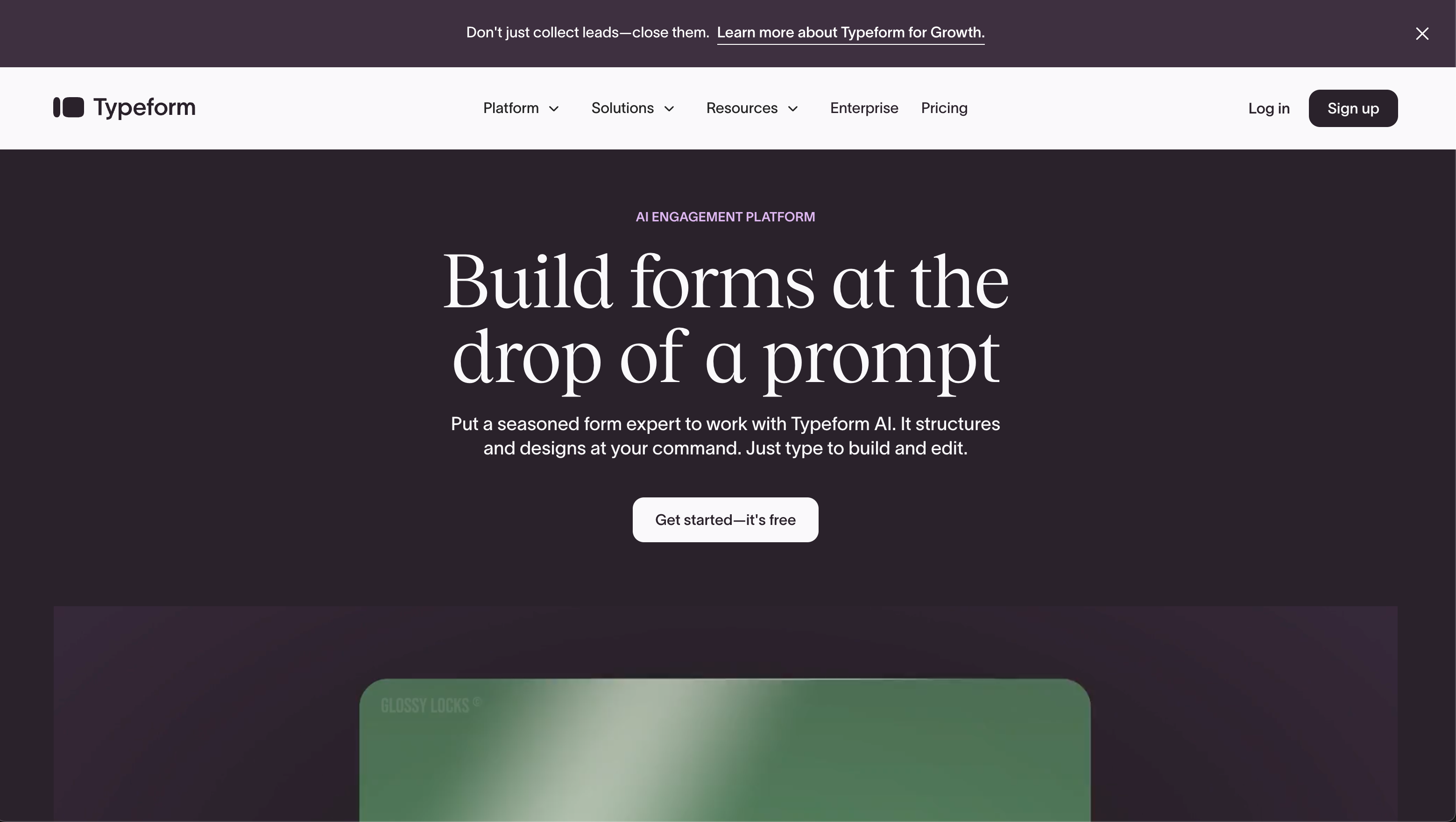
Typeform's one-question-at-a-time format creates a conversational, engaging experience that feels like a conversation rather than a form. Animations, backgrounds, custom layouts, and brand theming create forms that look premium. Airtable Forms is a flat list of fields with a cover image. For customer-facing forms, brand experiences, and survey engagement, the design gap is enormous.
Logic Jumps (Conditional Logic)
Typeform supports logic jumps — routing respondents to different questions based on answers. Create branching paths, skip irrelevant sections, and personalise the experience. Airtable Forms has no conditional logic. Every respondent sees every field. For any form that should adapt to answers, Typeform delivers what Airtable Forms cannot.
Higher Completion Rates
Typeform's format reduces cognitive load — respondents focus on one question at a time without being overwhelmed by a wall of fields. For longer forms (10+ questions), this demonstrably improves completion rates. Airtable Forms' all-at-once approach can feel overwhelming for longer forms, leading to higher abandonment.
Payment Processing
Typeform integrates with Stripe for payment collection within forms. Airtable Forms has zero payment capability. For forms that collect money — event registrations, product orders, donations — Typeform is the only option between these two.
Hidden Fields and Answer Piping
Typeform supports hidden fields (pre-populating data from URLs) and answer piping (inserting previous answers into later questions — "Thanks [name], now tell us about..."). These personalisation features create a tailored experience. Airtable Forms has no piping and limited prefill capability.
Where Airtable Forms Falls Short
- No design control: Cover image and field ordering. No themes, animations, or brand customisation.
- No conditional logic: Every respondent sees every field. No branching or skip logic.
- No payment processing: Zero payment capability.
- No answer piping: Previous answers can't appear in later questions.
- No engagement features: No conversational format, no animations, no progress indicators.
- Record limits: Free plan caps at 1,000 records per base.
Where Typeform Falls Short
- No relational database: Responses stored in Typeform's system, not a relational database with views and linked records.
- Expensive for volume: Response limits on all plans. Basic: 100/month ($25/mo), Plus: 1,000/month ($50/mo). High-volume collection gets costly.
- Restrictive free plan: 10 responses/month is essentially unusable for real data collection.
- One-at-a-time can frustrate: For short, simple forms, clicking through one question at a time adds unnecessary clicks.
- Limited calculations: No real-time calculations, dynamic pricing, or formula-driven logic within forms.
- No e-signatures: No signature field for contracts or agreements.
- No native Airtable backend: Typeform can integrate with Airtable, but it's not as frictionless as Airtable Forms' native connection.
Pricing Comparison
Free database widget vs premium design tool — fundamentally different value propositions.
| Tier | Airtable (includes Forms) | Typeform | Key Difference |
|---|---|---|---|
| Free | 1,000 records/base, basic forms | 10 responses/mo, 10 questions | Airtable's free tier is actually usable; Typeform's is a demo |
| Entry | Team: $20/user/mo — 50K records | Basic: $25/mo — 100 responses/mo | Airtable is per-user; Typeform is per-account with response caps |
| Mid | Business: $45/user/mo | Plus: $50/mo — 1,000 responses/mo | Similar price; Airtable gives database, Typeform gives responses |
| Business | Enterprise Scale: Custom | Business: $83/mo — 10K responses/mo | Typeform's business tier is transparent; Airtable is custom |
Airtable Forms
Typeform
| Product | Plan | Monthly Price | Annual Price (per month) | Free Plan | Free Trial | Limits |
|---|---|---|---|---|---|---|
| Airtable Forms | Free | Free | Free | Yes | 14 days | None listed |
| Airtable Forms | Team | $24/mo | $20/mo billed annually | None listed | ||
| Airtable Forms | Business | $54/mo | $45/mo billed annually | None listed | ||
| Airtable Forms | Enterprise Scale | Custom | Custom | None listed | ||
| Typeform | Free | Free | Free | Yes | No | forms: 10, submissions: 10/month, users: 1 |
| Typeform | Basic | $39/mo | $28/mo billed annually | forms: Unlimited, submissions: 100/month, users: 1 | ||
| Typeform | Plus | $79/mo | $56/mo billed annually | forms: Unlimited, submissions: 1,000/month, users: 3 | ||
| Typeform | Business | $129/mo | $91/mo billed annually | forms: Unlimited, submissions: 10,000/month, users: 5 | ||
| Typeform | Growth Pro | $379/mo | $266/mo billed annually | forms: Unlimited, submissions: Expanded, users: Expanded |
What Users Say
Typeform is praised for its beautiful design and engaging respondent experience. Criticism centres on pricing, response limits, and limited features beyond design (no calculations, limited payments). Airtable reviews focus on the database platform; form-specific feedback consistently notes the builder is too basic. The consensus: Typeform wins on experience, Airtable wins on data management, neither is a complete form solution.
Consider Paperform
If you want Typeform-level design without the response limits and with more form-building power, Paperform is the alternative. Paperform's document-style editor creates forms resembling designed landing pages — not one-at-a-time, but visually rich with text, images, videos, and fields coexisting freely. Its Excel-style calculation engine powers dynamic pricing, scoring, and conditional totals that Typeform lacks entirely.
At $24/month (annual), Paperform includes five payment gateways (vs Typeform's one), 2,000+ integrations (including Airtable), 30,000+ templates, e-signatures, and no per-response pricing. Better calculations than Typeform, better design than Airtable Forms, better value than both. Founded in 2016, bootstrapped and profitable. See our full ranking.
The Verdict
Typeform wins on form experience. The conversational format, premium design, logic jumps, and answer piping create an engaging respondent experience that Airtable Forms cannot approach. For customer-facing forms where engagement matters, Typeform is the better tool.
Airtable Forms wins on data backend and cost. The relational database, multiple views, and automations make Airtable stronger for data management. And free beats $25+/month for teams that need basic data collection without design requirements.
The pragmatic approach for many teams: use Typeform for customer-facing forms connected to Airtable via integration. You get Typeform's premium experience for data collection and Airtable's database for data management. Typeform (founded 2012, Barcelona, $187M raised) and Airtable (founded 2012, $735M raised) are both well-funded and stable platforms.
Frequently Asked Questions
Is Typeform worth paying for over free Airtable Forms?
If design and respondent experience matter, yes. Typeform's one-question-at-a-time interface creates a conversational, engaging experience that achieves higher completion rates for customer-facing forms. Airtable Forms shows all fields at once with minimal design. For surveys, lead generation, and customer-facing forms where engagement drives results, Typeform's premium is justified. For internal data entry where nobody cares about aesthetics, Airtable Forms is free and adequate.
Can Typeform send data to Airtable?
Yes. Typeform has a native Airtable integration that maps form fields to Airtable columns, creating records on submission. This is one of Typeform's most popular integrations. You get Typeform's beautiful, conversational forms for data collection and Airtable's relational database for data management — the best of both worlds for teams that use Airtable.
Does Typeform have a free plan?
Yes. Typeform offers a free plan with 10 questions per form and 10 responses/month. It includes the one-question-at-a-time format and basic logic jumps. The 10 response/month limit is severely restrictive for real use. Airtable's free plan allows 1,000 records per base — far more generous on volume. Typeform's free tier demonstrates the product; Airtable's free tier is actually usable for basic data collection.
Which has better completion rates?
Typeform's one-question-at-a-time format typically achieves higher completion rates for surveys and customer-facing forms — the conversational experience reduces cognitive load. Airtable Forms shows all fields at once, which can feel overwhelming for longer forms. For short internal forms (5-10 fields), format doesn't matter much. For longer customer-facing forms, Typeform's approach demonstrably improves engagement.
Sources & References
- Typeform: People-Friendly Forms and Surveys — Typeform, 2026
- Airtable Form View Documentation — Airtable, 2026
Last updated March 21, 2026
Ready to try Paperform?
Create beautiful forms, payment pages, and workflows — no code required.