Airtable Forms vs Gravity Forms: Database Widget or WordPress Plugin? (2026)
Two ecosystem-locked form tools. Airtable Forms exists only within Airtable — a basic data entry widget that feeds records into your bases. Gravity Forms exists only within WordPress — a powerful form plugin with conditional logic, payments, add-ons, and deep CMS integration. Neither works outside its platform.
The comparison depends entirely on your stack. WordPress users should consider Gravity Forms. Airtable users can use Airtable Forms for simple intake. If you use both, connecting Gravity Forms to Airtable via Zapier gives you the best of both worlds.
Quick Verdict
Choose Airtable Forms if:
- You use Airtable and need simple data entry into bases
- You don't have WordPress
- The form is internal and doesn't need logic or payments
- You want zero additional cost with your Airtable account
Choose Gravity Forms if:
- You have a WordPress site and need forms embedded in it
- You need conditional logic, multi-page forms, or branching
- You need payment processing (Stripe, PayPal)
- You want a massive add-on ecosystem for extensibility
- You need WordPress user registration or content submission
Feature Comparison
Gravity Forms is a full-featured form plugin; Airtable Forms is a basic data entry widget. Both are platform-locked.
| Feature | Airtable Forms | Gravity Forms |
|---|---|---|
| Form Building | ||
| Document-style editor | No | No |
| AI form creation | No | No |
| Field types | Yes | No |
| Multi-page forms | No | Yes Basic |
| Guided mode (one question at a time) | No | Yes Elite |
| Conditional logic | No | Yes Basic |
| Calculations field | No | Yes Basic |
| AI calculations assistant | No | No |
| Scoring | No | Yes Elite |
| Answer piping | No | Yes Basic |
| Pre-filling and hidden fields | Yes | Yes Basic |
| Save and resume | No | Yes Basic |
| Auto-close by number | No | No |
| Auto-close by date | No | No |
| Appointment/booking field | No | No |
| Signature field | No | Yes Elite |
| Color picker field | No | No |
| API-powered dropdowns | No | No |
| Google address search | No | No |
| Drag-and-drop builder | No | Yes Basic |
| 30+ field types | No | Yes Basic |
| Payments | ||
| Stripe payments | No | Yes Pro |
| PayPal payments | No | Yes Pro |
| Square payments | No | Yes Pro |
| Braintree payments | No | No |
| Google Pay | No | Yes Pro |
| Product sales (eCommerce) | No | Yes Basic |
| Subscriptions | No | Yes Pro |
| Coupons and discounts | No | Yes Elite |
| Custom pricing rules | No | No |
| Tax calculations | No | No |
| Quotes/invoices | No | No |
| Refunds | No | Yes Pro |
| 3D Secure | No | Yes Pro |
| Design & Customization | ||
| Template gallery | No | Yes Basic |
| Rich media (images, GIFs, videos) | Yes | Yes Basic |
| Unsplash and Giphy integration | No | No |
| Image editor | No | No |
| Adobe CC | No | No |
| Language translation | No | Yes Basic |
| Advanced theming | Yes business | Yes Basic |
| Custom form URL | No | No |
| Custom domains | No | No |
| Custom HTML & CSS | No | Yes Basic |
| Remove branding | Yes business | Yes Basic |
| Custom email domains | No | Yes Elite |
| Analytics | ||
| Submission results and reports | Yes | Yes Basic |
| AI report insights | No | No |
| Form analytics | No | No |
| Google Analytics & Facebook Pixel | No | Yes Elite |
| Custom analytics scripts | No | Yes Basic |
| Partial submissions | No | Yes Elite |
| Paperform analytics | No | No |
| Collaboration | ||
| Multi-user accounts | Yes | Yes Basic |
| User permissions and management | Yes team | Yes Basic |
| Advanced permissions & admin | Yes enterprise | No |
| Form sharing (templates) | Yes | Yes Basic |
| Workspace organization | Yes | No |
| Spaces and tag management | No | No |
| Security | ||
| SOC 2 Type II | Yes | No |
| GDPR compliant | Yes | Yes Basic |
| SSL encryption | Yes | Yes Basic |
| Two-factor authentication | Yes | No |
| Enforce 2FA | Yes enterprise | No |
| SSO (SAML) | Yes business | No |
| reCAPTCHA | No | Yes Basic |
| Data residency | Yes enterprise | No |
| Custom S3 | No | No |
| Enforce 2FA for all users | No | No |
| Local data residency | No | Yes Basic |
| Custom S3 storage (BYO) | No | No |
| Integrations & API | ||
| Native integrations | No | No |
| Zapier | Yes | Yes Pro |
| Make (Integromat) | Yes | No |
| Webhooks | Yes team | Yes Elite |
| API | Yes | No |
| Business API | No | No |
| WordPress plugin | No | Yes Basic |
| Embed options | Yes | No |
| 50+ official add-ons | No | Yes Basic |
| Standard API | No | Yes Basic |
| oEmbed support | No | No |
| Stepper workflow automation | No | No |
Where Airtable Forms Wins

No WordPress Required
Airtable Forms works from any browser — no hosting, no CMS, no server management. Gravity Forms requires a self-hosted WordPress installation with PHP, a database, and regular updates. For teams without WordPress (or without the desire to maintain it), Airtable Forms is accessible immediately.
Relational Database Backend
Submissions land in Airtable's relational database with linked records, multiple views, automations, and formulas. Gravity Forms stores entries in WordPress's MySQL database — functional but not a relational database designed for data management. For teams that need to relate, filter, and visualise form data, Airtable's backend is significantly more capable.
Free With Airtable
Airtable Forms is included with every Airtable plan. Gravity Forms starts at $59/year and requires WordPress hosting costs on top. For teams already in Airtable, forms add zero marginal cost.
Where Gravity Forms Wins
Conditional Logic
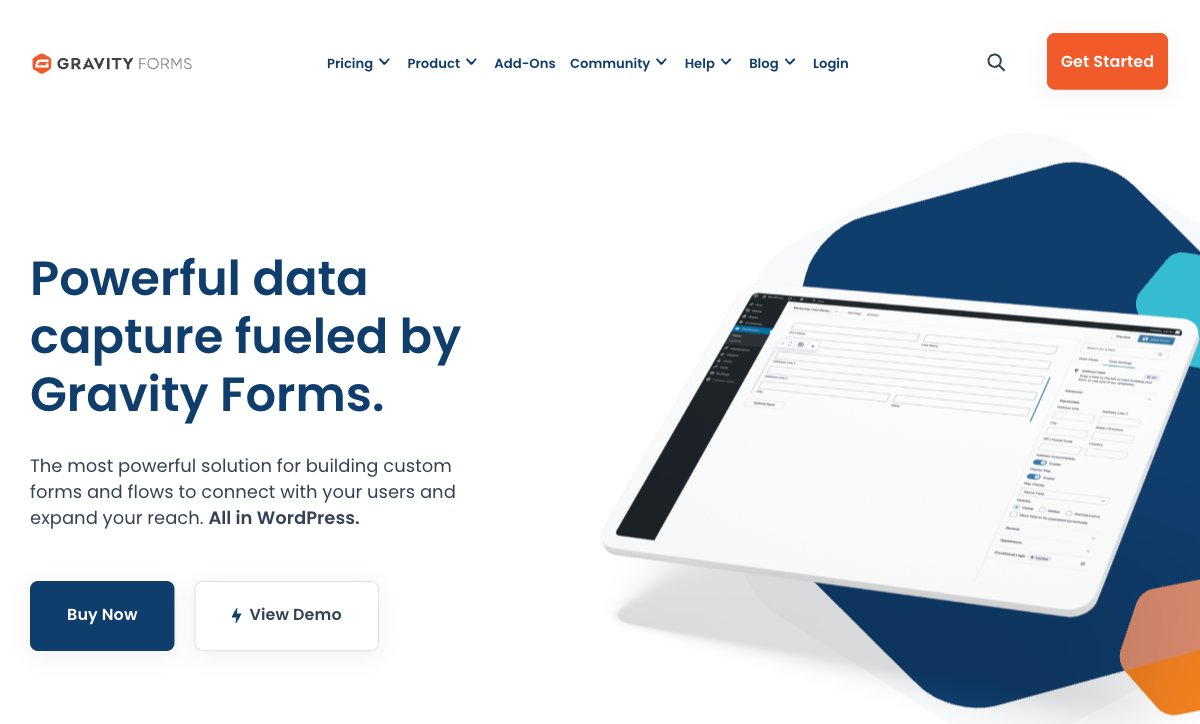
Gravity Forms supports advanced conditional logic — show/hide fields, conditional page breaks, conditional notifications, conditional confirmations, and calculated fields. Airtable Forms has no conditional logic. For any form that needs to adapt to respondent answers, Gravity Forms delivers what Airtable Forms cannot.
Payment Processing
Gravity Forms integrates with Stripe, PayPal, and other gateways through official add-ons. Order forms, donation forms, subscription billing, and product purchases work directly within WordPress. Airtable Forms has zero payment capability.
Massive Add-On Ecosystem
Gravity Forms has one of the largest form plugin ecosystems — official add-ons for CRMs (Salesforce, HubSpot, Zoho), email marketing (Mailchimp, ActiveCampaign), payment gateways, surveys, polls, quizzes, user registration, and more. Third-party developers extend it further. Airtable Forms has no add-on system — its capabilities are fixed and minimal.
WordPress Integration
Gravity Forms embeds natively in WordPress pages and posts, supports user registration, content submission, and member-only forms. It hooks into WordPress themes, plugins, and the admin dashboard. For WordPress-powered websites, this native integration is unmatched by any standalone form tool.
Calculations and Merge Tags
Gravity Forms supports calculated fields and merge tags that pipe answers into notifications, confirmations, and other fields. Airtable has database formulas, but forms cannot display calculated values during completion. For pricing calculators or dynamic forms, Gravity Forms' calculations work in real time.
Where Airtable Forms Falls Short
- No conditional logic: Every respondent sees every field. No branching or skip logic.
- No payment processing: Zero payment gateway support.
- No add-on ecosystem: Fixed, minimal feature set with no extensibility.
- No calculations on forms: Formulas exist in the database but not on the form.
- Minimal design control: Cover image and description only.
- Record limits: Free plan caps at 1,000 records per base.
Where Gravity Forms Falls Short
- Requires WordPress: No standalone option. Must have self-hosted WordPress with hosting costs and maintenance.
- No relational database: Entries stored in WordPress's MySQL. No Kanban, Calendar, or Gallery views.
- Add-on costs add up: Many useful features (CRMs, payment gateways, surveys) require the Elite license ($259/year) or separate add-on purchases.
- No native Airtable integration: Connecting to Airtable requires Zapier or third-party add-ons.
- Security responsibility: Self-hosted WordPress means you're responsible for updates, backups, and security patches.
- No hosted form option: Forms can't be shared as standalone pages without a WordPress site.
Pricing Comparison
Airtable Forms is free with the platform; Gravity Forms is an annual WordPress license.
| Tier | Airtable (includes Forms) | Gravity Forms | Key Difference |
|---|---|---|---|
| Free / Basic | Free — 1,000 records/base | Basic: $59/yr — 1 site, core features | Airtable is free; Gravity Forms is ~$5/mo |
| Mid | Team: $20/user/mo | Pro: $159/yr — 3 sites, more add-ons | Airtable is per-user; Gravity Forms is per-site |
| Top | Business: $45/user/mo | Elite: $259/yr — unlimited sites, all add-ons | Gravity Forms Elite is ~$22/mo for unlimited sites |
Airtable Forms
Gravity Forms
| Product | Plan | Monthly Price | Annual Price (per month) | Free Plan | Free Trial | Limits |
|---|---|---|---|---|---|---|
| Airtable Forms | Free | Free | Free | Yes | 14 days | None listed |
| Airtable Forms | Team | $24/mo | $20/mo billed annually | None listed | ||
| Airtable Forms | Business | $54/mo | $45/mo billed annually | None listed | ||
| Airtable Forms | Enterprise Scale | Custom | Custom | None listed | ||
| Gravity Forms | Basic | Not listed | $59/mo billed annually | No | 14 days | forms: Unlimited, submissions: Unlimited, storage: WordPress database (self-hosted), users: Unlimited (WordPress users) |
| Gravity Forms | Pro | Not listed | $159/mo billed annually | forms: Unlimited, submissions: Unlimited, storage: WordPress database (self-hosted), users: Unlimited (WordPress users) | ||
| Gravity Forms | Elite | Not listed | $259/mo billed annually | forms: Unlimited, submissions: Unlimited, storage: WordPress database (self-hosted), users: Unlimited (WordPress users) | ||
| Gravity Forms | Nonprofit | Not listed | $129/mo billed annually | forms: Unlimited, submissions: Unlimited, storage: WordPress database (self-hosted), users: Unlimited (WordPress users) |
What Users Say
Gravity Forms is one of the highest-rated WordPress plugins, praised for reliability, extensibility, and developer-friendliness. The add-on ecosystem and conditional logic are frequently highlighted. Airtable reviews focus on the database — form feedback consistently notes the builder is too basic. In the WordPress ecosystem, Gravity Forms is a trusted standard. In the Airtable ecosystem, forms are an afterthought.
Consider Paperform
If you don't want WordPress dependency or Airtable's form limitations, Paperform is a standalone alternative. Paperform's document-style editor creates forms resembling designed landing pages, with an Excel-style calculation engine that powers dynamic pricing, scoring, and conditional totals across questions, pages, emails, integrations, and success pages.
At $24/month (annual), Paperform includes five payment gateways, 2,000+ integrations (including Airtable), 30,000+ templates, e-signatures, and conditional logic — no WordPress required. Embeddable anywhere, hostable on custom domains. Founded in 2016, bootstrapped and profitable. See our full ranking.
The Verdict
Gravity Forms wins as a form builder. Conditional logic, payment processing, calculations, a massive add-on ecosystem, and deep WordPress integration make it a complete form solution — but only for WordPress sites.
Airtable Forms wins as a data backend. The relational database, multiple views, and automations make Airtable stronger for managing data after collection — but the forms themselves are minimal.
Both are well-established. Gravity Forms (by Rocketgenius, founded 2008) powers millions of WordPress forms. Airtable (founded 2012, $735M raised) serves 500,000+ organisations. Platform stability is solid for both. The choice is your stack: WordPress or Airtable.
Frequently Asked Questions
Can Gravity Forms send data to Airtable?
Yes. Gravity Forms connects to Airtable through Zapier, Make, and third-party add-ons. Form submissions can create or update Airtable records automatically. This gives you Gravity Forms' conditional logic, payments, and WordPress integration on the frontend with Airtable's database on the backend. For WordPress sites that also use Airtable, this combination works well.
Do I need WordPress for Gravity Forms?
Yes. Gravity Forms is a WordPress plugin — it requires a self-hosted WordPress installation. It doesn't work as a standalone form builder. Airtable Forms is platform-independent, accessible from any browser. If you don't have WordPress, Gravity Forms isn't an option. If you do have WordPress, Gravity Forms offers deep CMS integration that Airtable Forms can't match.
Which is cheaper?
Airtable Forms is free with any Airtable account. Gravity Forms starts at $59/year (Basic license) — roughly $5/month. However, Gravity Forms requires WordPress hosting (additional cost) while Airtable Forms requires an Airtable account (free tier available). Total cost depends on your existing stack. If you already have WordPress, Gravity Forms is inexpensive. If you already have Airtable, Airtable Forms is free.
Which has more add-ons and extensions?
Gravity Forms has a massive ecosystem of official and third-party add-ons — payment gateways (Stripe, PayPal), CRM connectors (Salesforce, HubSpot), email marketing, conditional logic enhancements, surveys, polls, quizzes, user registration, and more. Airtable Forms has no add-on ecosystem. Its form functionality is fixed. For extensibility, Gravity Forms wins decisively.
Sources & References
- Gravity Forms: WordPress Form Builder Plugin — Gravity Forms, 2026
- Airtable Form View Documentation — Airtable, 2026
Last updated March 21, 2026
Ready to try Paperform?
Create beautiful forms, payment pages, and workflows — no code required.