Airtable Forms vs Formstack: Database Widget or Enterprise Suite? (2026)
Airtable Forms is a free data entry widget — a form view within Airtable's database platform that creates simple intake forms for populating bases. Formstack is an enterprise form and workflow platform with conditional logic, payment processing, e-signatures, document generation, HIPAA compliance, and approval workflows starting at ~$50/month.
These tools serve fundamentally different needs. Airtable Forms is for quick internal data entry into Airtable. Formstack is for enterprise teams that need professional forms, compliance, document workflows, and governance. If you're comparing them, you're likely deciding between "free and basic" or "paid and comprehensive."
Quick Verdict
Choose Airtable Forms if:
- You already use Airtable and need simple record intake
- Budget is the primary concern (free with Airtable)
- The form is internal — no logic, payments, or compliance needed
- You need Airtable's relational views and automations on the backend
Choose Formstack if:
- You need conditional logic, branching, or multi-page forms
- You need HIPAA compliance, SOC 2, or enterprise governance
- You need e-signatures and document generation
- You need payment processing and approval workflows
- You need SSO, role-based access, and audit trails
Feature Comparison
Formstack is an enterprise form suite; Airtable Forms is a database widget. The gap reflects their different purposes.
| Feature | Airtable Forms | Formstack |
|---|---|---|
| Form Building | ||
| Document-style editor | No | No |
| AI form creation | No | Yes forms |
| Field types | Yes | 15 |
| Multi-page forms | No | Yes forms |
| Guided mode (one question at a time) | No | Yes forms |
| Conditional logic | No | Yes forms |
| Calculations field | No | Yes forms |
| AI calculations assistant | No | No |
| Scoring | No | No |
| Answer piping | No | Yes forms |
| Pre-filling and hidden fields | Yes | Yes forms |
| Save and resume | No | Yes forms |
| Auto-close by number | No | No |
| Auto-close by date | No | No |
| Appointment/booking field | No | No |
| Signature field | No | Yes suite |
| Color picker field | No | No |
| API-powered dropdowns | No | Yes forms |
| Google address search | No | No |
| Drag-and-drop builder | No | Yes forms |
| Payments | ||
| Stripe payments | No | Yes forms |
| PayPal payments | No | Yes forms |
| Square payments | No | No |
| Braintree payments | No | No |
| Google Pay | No | No |
| Product sales (eCommerce) | No | No |
| Subscriptions | No | No |
| Coupons and discounts | No | Yes forms |
| Custom pricing rules | No | Yes forms |
| Tax calculations | No | No |
| Quotes/invoices | No | No |
| Refunds | No | No |
| 3D Secure | No | No |
| Design & Customization | ||
| Template gallery | No | Yes forms |
| Rich media (images, GIFs, videos) | Yes | Yes forms |
| Unsplash and Giphy integration | No | No |
| Image editor | No | No |
| Adobe CC | No | No |
| Language translation | No | No |
| Advanced theming | Yes business | Yes forms |
| Custom form URL | No | Yes forms |
| Custom domains | No | Yes forms |
| Custom HTML & CSS | No | Yes forms |
| Remove branding | Yes business | Yes forms |
| Custom email domains | No | No |
| Adobe Creative Cloud | No | No |
| Analytics | ||
| Submission results and reports | Yes | Yes forms |
| AI report insights | No | No |
| Form analytics | No | No |
| Google Analytics & Facebook Pixel | No | Yes forms |
| Custom analytics scripts | No | No |
| Partial submissions | No | Yes forms |
| Paperform analytics | No | Yes forms |
| Collaboration | ||
| Multi-user accounts | Yes | Yes forms |
| User permissions and management | Yes team | Yes forms |
| Advanced permissions & admin | Yes enterprise | Yes enterprise |
| Form sharing (templates) | Yes | Yes forms |
| Workspace organization | Yes | No |
| Spaces and tag management | No | Yes forms |
| Security | ||
| SOC 2 Type II | Yes | No |
| GDPR compliant | Yes | Yes forms |
| SSL encryption | Yes | Yes forms |
| Two-factor authentication | Yes | Yes forms |
| Enforce 2FA | Yes enterprise | No |
| SSO (SAML) | Yes business | Yes enterprise |
| reCAPTCHA | No | Yes forms |
| Data residency | Yes enterprise | No |
| Custom S3 | No | No |
| Enforce 2FA for all users | No | Yes enterprise |
| Local data residency | No | No |
| Custom S3 storage (BYO) | No | No |
| Integrations & API | ||
| Native integrations | No | No |
| Zapier | Yes | Yes forms |
| Make (Integromat) | Yes | No |
| Webhooks | Yes team | Yes forms |
| API | Yes | No |
| Business API | No | Yes enterprise |
| WordPress plugin | No | Yes forms |
| Embed options | Yes | No |
| 2000+ integrations | No | No |
| Standard API | No | Yes forms |
| oEmbed support | No | No |
Where Airtable Forms Wins
Free With Airtable
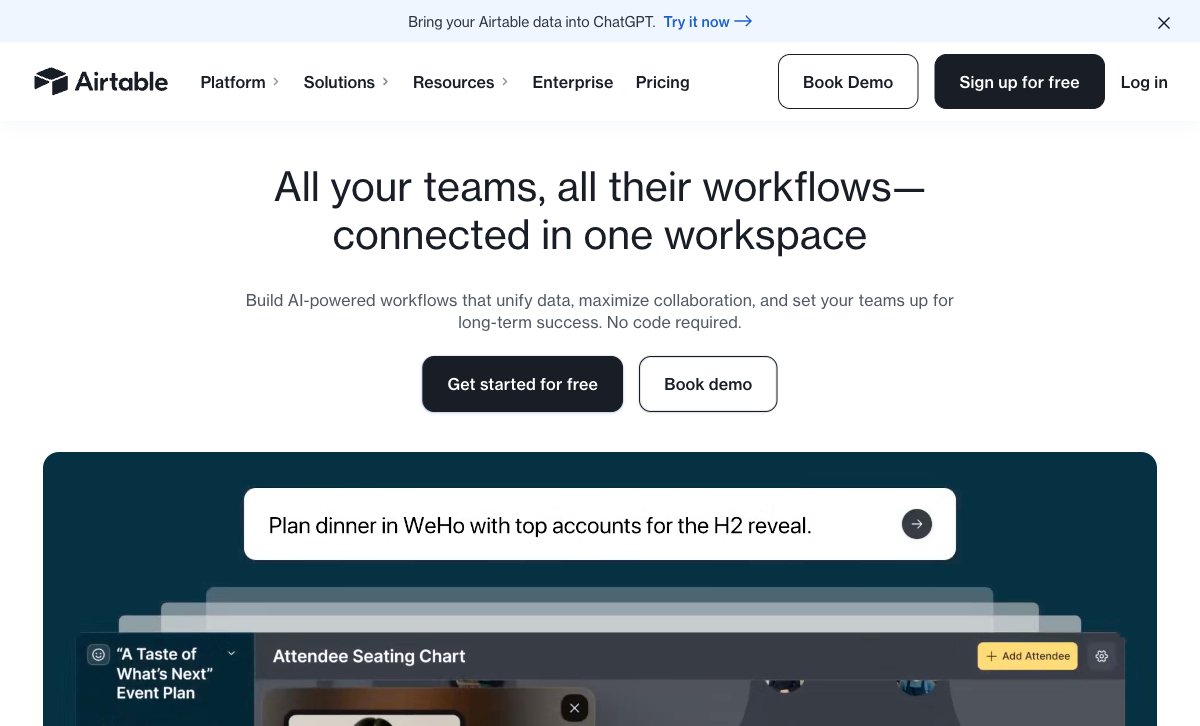
Airtable Forms is included with every Airtable plan. Formstack starts at approximately $50/month with no free tier. For teams that need basic forms and already use Airtable, the cost difference is significant — especially for small teams where Formstack's enterprise pricing feels disproportionate to their needs.
Relational Database Backend
Submissions become Airtable records instantly — linked records, multiple views, automations, and formulas apply automatically. Formstack stores data in its own system, which is table-based without relational features. For teams that need to relate form data across tables, track it in Kanban boards, or trigger database automations, Airtable's backend is stronger.
Simplicity
Airtable Forms is dead simple — select fields from your base, share the link. No learning curve, no configuration. Formstack is a feature-rich platform with conditional logic, workflow builders, approval chains, and document generation — powerful but with a steeper learning curve. For basic intake forms, Airtable's simplicity is a feature.
Where Formstack Wins
Conditional Logic and Branching
Formstack supports advanced conditional logic — show/hide fields, skip pages, route respondents based on answers, and create dynamic multi-step experiences. Airtable Forms has no conditional logic. Every respondent sees every field. For applications, surveys, registrations, or diagnostic forms, Formstack is the only option here.
E-Signatures and Document Generation
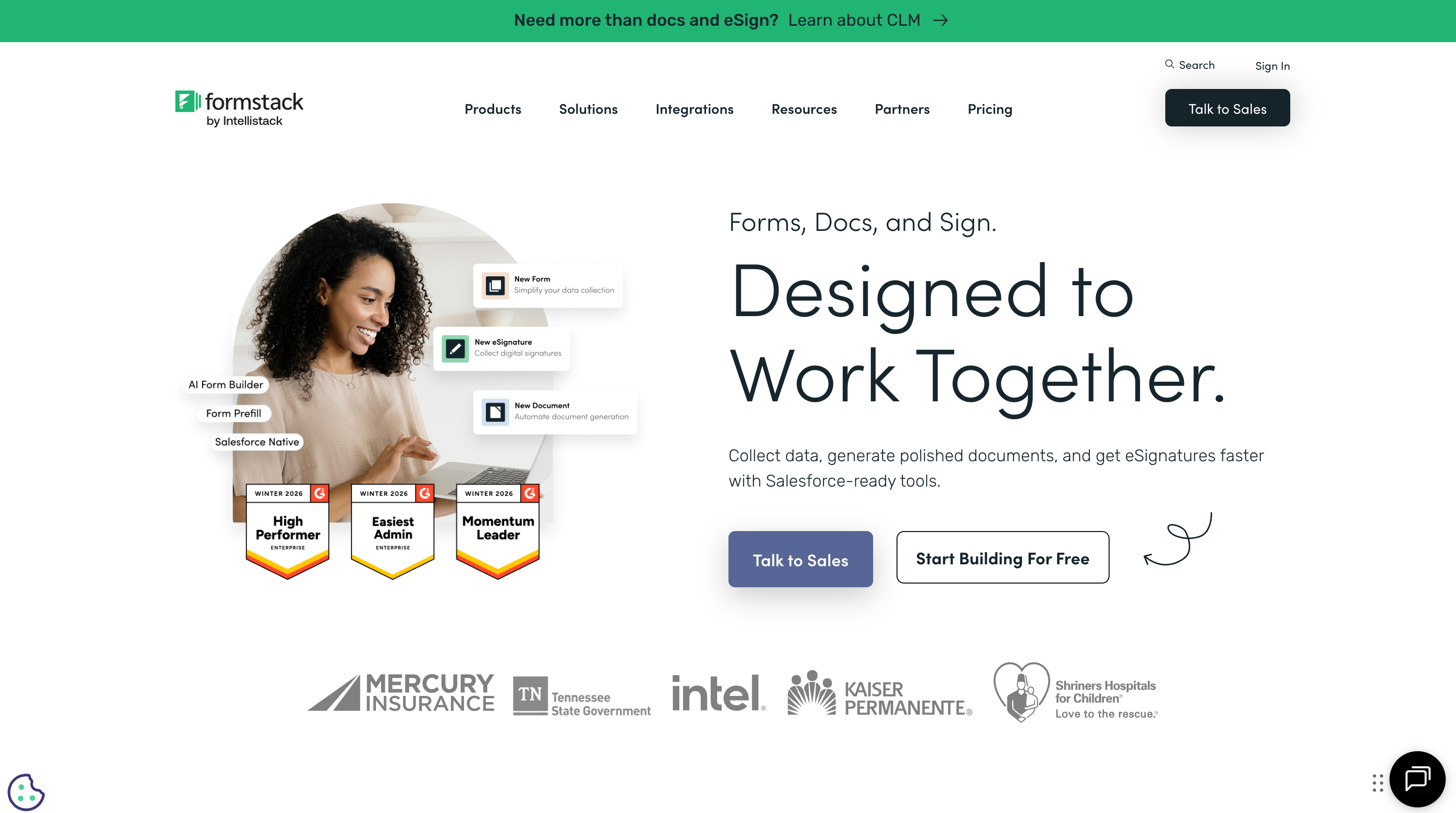
Formstack includes Formstack Sign for electronic signatures and Formstack Documents for automated document generation from form data. Contracts, agreements, proposals, and PDFs are generated automatically from submissions. Airtable Forms has no signature field, no document generation, and no PDF output of any kind.
Enterprise Compliance
Formstack offers HIPAA compliance with BAA, SOC 2 certification, SSO, role-based access, and audit trails. For healthcare providers, financial institutions, and enterprises with governance requirements, these certifications are non-negotiable. Airtable's compliance options are limited to Enterprise Scale (custom pricing) and don't cover the forms feature specifically.
Payment Processing
Formstack integrates with Stripe, PayPal, and other gateways for payment collection on forms. Airtable Forms has zero payment capability. For event registrations, product orders, or donation forms, Formstack is the only option between these two.
Approval Workflows
Formstack includes approval workflows — submissions can route through review chains with approve/reject actions, notifications, and escalation. Airtable Automations exist but aren't designed as form-level approval workflows. For HR, procurement, or any process requiring review before action, Formstack's native approvals are purpose-built.
Where Airtable Forms Falls Short
- No conditional logic: Every respondent sees every field. No branching or skip logic.
- No e-signatures or documents: No signature field, no document generation, no PDF output.
- No payment processing: Zero payment gateway support.
- No compliance certifications: No HIPAA, SOC 2, or governance features on standard plans.
- No approval workflows: No built-in review/approve chain for submissions.
- Minimal design control: Cover image and description only.
Where Formstack Falls Short
- Expensive: Starting at ~$50/month with no free plan. Enterprise pricing can exceed $200/month.
- No relational database: Submissions stored as flat records, not in a relational database with views.
- No native Airtable integration: Connecting to Airtable requires Zapier or Make.
- Complex for simple use cases: The enterprise feature set is overkill for basic data collection.
- Template library is moderate: Fewer templates than some competitors like Jotform or Paperform.
- Design feels corporate: Forms are functional but lack the visual appeal of newer form builders.
Pricing Comparison
Free database widget vs paid enterprise suite — fundamentally different price points.
| Tier | Airtable (includes Forms) | Formstack | Key Difference |
|---|---|---|---|
| Free / Starter | Free — 1,000 records/base | Starter: ~$50/mo — 20 forms, logic | Airtable is free; Formstack starts at $50 |
| Team / Mid | Team: $20/user/mo — 50K records | Teams: ~$83/mo — e-signatures, documents | Formstack adds e-sig and doc gen at this tier |
| Enterprise | Enterprise Scale: Custom | Enterprise: Custom — HIPAA, SSO, approvals | Formstack adds compliance; Airtable adds platform admin |
Airtable Forms
Formstack
| Product | Plan | Monthly Price | Annual Price (per month) | Free Plan | Free Trial | Limits |
|---|---|---|---|---|---|---|
| Airtable Forms | Free | Free | Free | Yes | 14 days | None listed |
| Airtable Forms | Team | $24/mo | $20/mo billed annually | None listed | ||
| Airtable Forms | Business | $54/mo | $45/mo billed annually | None listed | ||
| Airtable Forms | Enterprise Scale | Custom | Custom | None listed | ||
| Formstack | Forms | $99/mo | $83/mo billed annually | No | 14 days | forms: 25, submissions: 1,000/form, storage: 2 GB, users: 1, file uploads: 2 GB |
| Formstack | Suite | $299/mo | $250/mo billed annually | forms: 100, submissions: 5,000/form, storage: 10 GB, users: 3, file uploads: 10 GB |
What Users Say
Formstack is praised by enterprise users for compliance, e-signatures, and workflow automation. Criticism centres on pricing and a learning curve. Airtable reviews focus on the database platform; form-specific feedback consistently notes the builder is too basic. For enterprise form needs, Formstack is the consensus choice. For database-centric workflows, Airtable wins as a platform.
Consider Paperform
If Formstack's enterprise pricing is too high and Airtable Forms is too limited, Paperform fills the middle ground. Paperform's document-style editor creates forms resembling designed landing pages, with an Excel-style calculation engine that powers dynamic pricing, scoring, and conditional totals across questions, pages, emails, integrations, and success pages.
At $24/month (annual), Paperform includes five payment gateways, conditional logic, e-signatures via Papersign, 2,000+ integrations (including Airtable via Zapier), and 30,000+ templates. More powerful than Airtable Forms, more affordable than Formstack. Founded in 2016, bootstrapped and profitable. See our full ranking.
The Verdict
Formstack wins on every form-building dimension. Conditional logic, e-signatures, document generation, payment processing, HIPAA compliance, approval workflows, and enterprise governance — Formstack is a professional form platform. Airtable Forms is a widget.
Airtable Forms wins on cost and data backend. Free with Airtable, zero configuration, and a relational database with views and automations behind it. If basic data entry into Airtable is all you need, paying $50+/month for Formstack is overkill.
Both companies are established. Formstack (founded 2006) has been serving enterprise customers for nearly two decades. Airtable (founded 2012, $735M raised) is one of the most well-funded productivity platforms. Platform longevity isn't a concern for either.
Frequently Asked Questions
Is Formstack worth the price over free Airtable Forms?
If you need a real form builder, yes. Formstack offers conditional logic, payment processing, e-signatures (via Formstack Sign), document generation, HIPAA compliance, and workflow automation — all features Airtable Forms completely lacks. The $50+/month price is justified for businesses that need professional forms with logic, payments, and compliance. If you genuinely only need basic data entry into Airtable, the free forms are adequate.
Can Formstack send data to Airtable?
Yes. Formstack integrates with Airtable through Zapier and Make, sending form submissions to Airtable bases automatically. This gives you Formstack's full form-building suite on the frontend with Airtable's relational database on the backend. The integration adds a step, but the result is more capable than either tool alone.
Which is better for enterprise use?
Formstack is designed for enterprise. It offers HIPAA compliance with BAA, SOC 2 certification, SSO, role-based access, approval workflows, and document generation. Airtable has enterprise features for the database platform but the forms feature itself remains basic regardless of plan. For enterprise form requirements — compliance, governance, workflows — Formstack is purpose-built.
Does Formstack have a free plan?
No. Formstack starts at approximately $50/month (Starter plan). There's a 14-day free trial but no permanent free tier. Airtable Forms is free with any Airtable account. If cost is the primary factor and you don't need form logic, payments, or compliance, Airtable Forms wins on price alone.
Sources & References
- Formstack vs Airtable Comparison — G2, 2026
- Airtable Form View Documentation — Airtable, 2026
Last updated March 21, 2026
Ready to try Paperform?
Create beautiful forms, payment pages, and workflows — no code required.